If you're just now starting to read these 'Correspondences' posts, I suggest going to the first one and starting there since this is a series of emails I sent to a new volunteer coming to serve in Madagascar and it might make more sense since I've posted them chronologically. Enjoy!
9February2014
Hey 'New Volunteer',
So this will likely be the last email correspondence you get from me
before you report to staging. I just wanna tell you: GET ON THE
FREAKING PLANE. It's hard to do and can be scary, but just let your
feet carry you forward and dive into this journey. It's tough to say
goodbye. It's tough to go into this not really knowing what you're
getting yourself into. But it'll be ok. And you're gonna love it. GET
ON THE FREAKING PLANE. I say that in jest, but that's how it all
starts. When you get to staging, seriously, look around you. Those
people in that room with you will become like family to you over the
next few months and years. Sure, you might not be able to stand a few
of them, but that's ok. Take pride in your stage! GET ON THE FREAKING
PLANE. Let yourself get swept up in this. You'll be fine.
Again, mentor day during training is March 15th, so I'll see you at
the training center then. And keep in mind that Peace Corps service is
nothing like Peace Corps training. You're going to be in a very
structured environment for the next couple months, but once you get to
site, you can throw all that out the window. You'll get through it and
life will be grand. GET ON THE FREAKING PLANE!
Take care, safe travels, and enjoy staging, homestay, and training!
James
PS: GET ON THE FREAKING PLANE.
Thursday, February 27, 2014

Correspondences (Email 4)
Part 4 of my emailing with a new volunteer coming to Madagascar. I've left out her writings for privacy purposes.
19January2014
Hi,
Yeah, I'm in the capital now at the Peace Corps house (Meva), which
has like 20 something beds for vols in-transit/in town for conferences
and such. My stage is slowly coming in this weekend until Wednesday
when our COS starts. Getting our going home dates and all other kinds
of fun facts! Oh, and we'll be filling out TONS of forms! The forms
fun never ends in PC haha.
The Ag sector (formerly Env/CED) has the most relaxed schedule of any
other sector in Mada. We tend to make our own schedule and it changes
from day to day, week to week, season to season. Planting/harvesting
seasons tend to be the busiest, where I would typically work about 4
days a week. During weeding/winter seasons, usually about 2 days a
week could be considered actual "work" days. Don't forget, the idea of
"work" in Peace Corps (and in Madagascar, in particular) is a very
loose idea. Telling someone some facts about American culture is work.
You learning something new about Malagasy culture is work. You're a
24/7 representative of America, so just being you is part of your job.
It can often be funny the ideas Malagasy people will get about America
just based upon your daily habits at site.
Days off at site tend to vary greatly from days off away from site. At
site, I tend to read a lot of books, play dominoes or cards with
friends, get into ridiculous conversations about peoples' perceptions
of America and the outside world (geography is real fun), cook a
badass meal, do laundry and clean, if you have electricity you can
watch movies, go to a place at your site you've never been to before,
work out, crunch up crackers and watch the ants carry it way if you're
REAL bored. Away from site, going out to eat is great, interneting
(posting pictures, skyping, emailing, etc), having a rum drink or a
warm beer.
James
19January2014
Hi,
Yeah, I'm in the capital now at the Peace Corps house (Meva), which
has like 20 something beds for vols in-transit/in town for conferences
and such. My stage is slowly coming in this weekend until Wednesday
when our COS starts. Getting our going home dates and all other kinds
of fun facts! Oh, and we'll be filling out TONS of forms! The forms
fun never ends in PC haha.
The Ag sector (formerly Env/CED) has the most relaxed schedule of any
other sector in Mada. We tend to make our own schedule and it changes
from day to day, week to week, season to season. Planting/harvesting
seasons tend to be the busiest, where I would typically work about 4
days a week. During weeding/winter seasons, usually about 2 days a
week could be considered actual "work" days. Don't forget, the idea of
"work" in Peace Corps (and in Madagascar, in particular) is a very
loose idea. Telling someone some facts about American culture is work.
You learning something new about Malagasy culture is work. You're a
24/7 representative of America, so just being you is part of your job.
It can often be funny the ideas Malagasy people will get about America
just based upon your daily habits at site.
Days off at site tend to vary greatly from days off away from site. At
site, I tend to read a lot of books, play dominoes or cards with
friends, get into ridiculous conversations about peoples' perceptions
of America and the outside world (geography is real fun), cook a
badass meal, do laundry and clean, if you have electricity you can
watch movies, go to a place at your site you've never been to before,
work out, crunch up crackers and watch the ants carry it way if you're
REAL bored. Away from site, going out to eat is great, interneting
(posting pictures, skyping, emailing, etc), having a rum drink or a
warm beer.
James
Correspondences (Email 3)
And here's Part 3 of my emailing with a new volunteer coming to work in Madagascar.
11January2014
Hey 'New Volunteer',
I hope you had a great holiday! Here's a little lowdown about Christmas in Mada:
Madagascar is a fairly Christian country throughout. Traditional
beliefs in the power of ancestors are also held all over the island
and are evident any many holiday/festival times. Christmas is not
anywhere as big of a deal here as it is in America. Yeah, there are
some decorations put up and you'll hear some music, but the big thing
is that people go to church a lot; Christmas Eve services and
Christmas day worship are big. A lot of PCVs will go on vacation at
this time, since being at site during Christmas can be kind of boring
and lonely since the Gasy don't make such a big deal of it. I went to
the beach last year, for example. But this year I stuck it out and had
Christmas at site, I dressed up as Santa Claus and gave out candy to
the kids in my town (which I NEVER do and don't suggest doing on any
regular basis), killed and ate a goose with my best friend at site's
family, played a lot of cards and dominoes, and some guys hooked up a
generator and we watched movies (ie: Rambo). New Year's I think is a
bigger party here than Christmas is. They do New Year's somewhat
similar to how we do. Stay up till midnight drinking, have a "ball"
(Gasy dance party), food, etc. There's a lot of drinking. Particularly
of Malagasy moonshine (taoka gasy). Horrid stuff.
To be a vegetarian in Madagascar is very easy. At most volunteers'
sites, meat is often not an option due to lack of electricity and,
therefor, refrigeration. Vegetables here are seasonable and mostly
organic. In fact, the veggies here are pretty awesome. So are the
fruits (get ready for lychees!). You may encounter some cultural
events in which beef is served but it's totally ok to turn it down.
The one problem that vegetarians encounter is when eating at a
Malagasy restaurant or at a local's house and there's no vegetarian
option. So, you might sometimes have to just bite the bullet and eat
the meat. In Mada, you also don't have to worry about whether food is
"free-range" or not, there aren't really any meat factories. Biggest
thing about food in Madagascar: get ready to eat a lifetime supply of
rice in your first 2 months. "Life is rice, rice is life".
To deal with attention and stuff like that: yeah, staying in your
house is always an option. Digging into a book, writing, listening to
music from home, listening to the BBC news on shortwave, cooking
something totally badass that takes a lot of time to make. You'll find
creative ways to take care of your self. If all else fails, get a
bottle of rum and kick back.
Electronics: bring a laptop, MP3 player, camera, a big hard drive (and
flash drive), and USB chargeable speakers. These are your PC
essentials. Don't come here without them. A lot of PCVs have Kindles
and love having them. A lot of PCVs also have iPhones and love having
them. You can get basic phones (talk and text) here for relatively
cheap. If you bring a phone from America, you'll still need to get a
SIM card for one of the Madagascar phone companies or have your phone
unlocked to function here (I didn't do this so I'm not the most
knowledgeable about phones). Radio is also a great thing to have at
site since the BBC comes in on shortwave, you bring a radio or get one
here. I charge everything once a week when I go to my market town, but
a lot of volunteers have sources at their sites to charge at (ie:
solar panels, someone with a generator). Phones here function on
credit, which you can buy most anywhere. It comes on little cards with
a code number, you enter the code number into your phone and send it
to your service provider and you immediately have phone credit. For
example, you load 2000Ariary (about $1) of credit onto your phone and
you can get about 15 text messages or 3 minutes of talk time within
Mada. To call outside of Mada, you'll run through your credit so fast
it won't even be worth your time. 2000Ariary will get you about 15
seconds worth of call time to the US. Texting is an ok option, which
costs about 400Ariary/text. I do this from time to time with my
family. Also, the phone companies offer call/text deals that you can
get to economize your phone use. You'll get hooked up with all that
during training, don't worry. PC will even hook you up with a basic,
but sturdy, phone using your move-in allowance once you get here.
Money: As an Ag Volunteer, you're going to likely be placed in a very
poor area. You will also likely be the most wealthy person in your
village. In my village, for example, the most anyone makes in a very
good month is around 200,000Ariary. The PC Mada monthly allowance is
about 460,000Ariary (around $230) a month. It's very easy to get by on
this, but it's also very easy to blow it with a trip to the capital or
to your banking town where you might wanna splurge. Be prepared to be
a budgeting master. You will be given a bank account and a debit card
(and checks) when you finish training. Every month, PC deposits your
monthly allowance into your account and you can pull it out from any
of your bank's ATMs or another bank's ATMs (with a charge) throughout
the island, not just in your banking town. Your banking town will be
the closest town to your site with a bank. Very similar to having a
checking account in America, except there's no such thing as
over-draft charges here cause you can't pull money out if you don't
actually have money in your account.
Things are starting to feel a bit crazy here for me and the folks in
my stage. We have our Close of Service (COS) conference in 2 weeks!
Wrapping things up. I'm sure it's starting to feel wild for you now
too, leaving next month woohoo!!! Eat as much of the food that you
know you're going to miss as you can get your hands on. There will be
a day where all of us mentors come out to the training center during
your training to talk with our mentors so we'll get to hang in
Mantasoa here in few months. Love that place!
Again, please don't forget that these are just my opinions about my
experience here. Everyone's service is unique and you may find things
to be quite different than how I describe them because of your
perspective and experience. And that's part of what makes PC so great!
Take care and don't be afraid to ask any questions that you're curious about!
James
11January2014
Hey 'New Volunteer',
I hope you had a great holiday! Here's a little lowdown about Christmas in Mada:
Madagascar is a fairly Christian country throughout. Traditional
beliefs in the power of ancestors are also held all over the island
and are evident any many holiday/festival times. Christmas is not
anywhere as big of a deal here as it is in America. Yeah, there are
some decorations put up and you'll hear some music, but the big thing
is that people go to church a lot; Christmas Eve services and
Christmas day worship are big. A lot of PCVs will go on vacation at
this time, since being at site during Christmas can be kind of boring
and lonely since the Gasy don't make such a big deal of it. I went to
the beach last year, for example. But this year I stuck it out and had
Christmas at site, I dressed up as Santa Claus and gave out candy to
the kids in my town (which I NEVER do and don't suggest doing on any
regular basis), killed and ate a goose with my best friend at site's
family, played a lot of cards and dominoes, and some guys hooked up a
generator and we watched movies (ie: Rambo). New Year's I think is a
bigger party here than Christmas is. They do New Year's somewhat
similar to how we do. Stay up till midnight drinking, have a "ball"
(Gasy dance party), food, etc. There's a lot of drinking. Particularly
of Malagasy moonshine (taoka gasy). Horrid stuff.
To be a vegetarian in Madagascar is very easy. At most volunteers'
sites, meat is often not an option due to lack of electricity and,
therefor, refrigeration. Vegetables here are seasonable and mostly
organic. In fact, the veggies here are pretty awesome. So are the
fruits (get ready for lychees!). You may encounter some cultural
events in which beef is served but it's totally ok to turn it down.
The one problem that vegetarians encounter is when eating at a
Malagasy restaurant or at a local's house and there's no vegetarian
option. So, you might sometimes have to just bite the bullet and eat
the meat. In Mada, you also don't have to worry about whether food is
"free-range" or not, there aren't really any meat factories. Biggest
thing about food in Madagascar: get ready to eat a lifetime supply of
rice in your first 2 months. "Life is rice, rice is life".
To deal with attention and stuff like that: yeah, staying in your
house is always an option. Digging into a book, writing, listening to
music from home, listening to the BBC news on shortwave, cooking
something totally badass that takes a lot of time to make. You'll find
creative ways to take care of your self. If all else fails, get a
bottle of rum and kick back.
Electronics: bring a laptop, MP3 player, camera, a big hard drive (and
flash drive), and USB chargeable speakers. These are your PC
essentials. Don't come here without them. A lot of PCVs have Kindles
and love having them. A lot of PCVs also have iPhones and love having
them. You can get basic phones (talk and text) here for relatively
cheap. If you bring a phone from America, you'll still need to get a
SIM card for one of the Madagascar phone companies or have your phone
unlocked to function here (I didn't do this so I'm not the most
knowledgeable about phones). Radio is also a great thing to have at
site since the BBC comes in on shortwave, you bring a radio or get one
here. I charge everything once a week when I go to my market town, but
a lot of volunteers have sources at their sites to charge at (ie:
solar panels, someone with a generator). Phones here function on
credit, which you can buy most anywhere. It comes on little cards with
a code number, you enter the code number into your phone and send it
to your service provider and you immediately have phone credit. For
example, you load 2000Ariary (about $1) of credit onto your phone and
you can get about 15 text messages or 3 minutes of talk time within
Mada. To call outside of Mada, you'll run through your credit so fast
it won't even be worth your time. 2000Ariary will get you about 15
seconds worth of call time to the US. Texting is an ok option, which
costs about 400Ariary/text. I do this from time to time with my
family. Also, the phone companies offer call/text deals that you can
get to economize your phone use. You'll get hooked up with all that
during training, don't worry. PC will even hook you up with a basic,
but sturdy, phone using your move-in allowance once you get here.
Money: As an Ag Volunteer, you're going to likely be placed in a very
poor area. You will also likely be the most wealthy person in your
village. In my village, for example, the most anyone makes in a very
good month is around 200,000Ariary. The PC Mada monthly allowance is
about 460,000Ariary (around $230) a month. It's very easy to get by on
this, but it's also very easy to blow it with a trip to the capital or
to your banking town where you might wanna splurge. Be prepared to be
a budgeting master. You will be given a bank account and a debit card
(and checks) when you finish training. Every month, PC deposits your
monthly allowance into your account and you can pull it out from any
of your bank's ATMs or another bank's ATMs (with a charge) throughout
the island, not just in your banking town. Your banking town will be
the closest town to your site with a bank. Very similar to having a
checking account in America, except there's no such thing as
over-draft charges here cause you can't pull money out if you don't
actually have money in your account.
Things are starting to feel a bit crazy here for me and the folks in
my stage. We have our Close of Service (COS) conference in 2 weeks!
Wrapping things up. I'm sure it's starting to feel wild for you now
too, leaving next month woohoo!!! Eat as much of the food that you
know you're going to miss as you can get your hands on. There will be
a day where all of us mentors come out to the training center during
your training to talk with our mentors so we'll get to hang in
Mantasoa here in few months. Love that place!
Again, please don't forget that these are just my opinions about my
experience here. Everyone's service is unique and you may find things
to be quite different than how I describe them because of your
perspective and experience. And that's part of what makes PC so great!
Take care and don't be afraid to ask any questions that you're curious about!
James
Correspondences (Email 2)
Here's the second email from my correspondences with an incoming Peace Corps Madagascar Volunteer.
23December2013
Hello again!
Yes, it's true that Peace Corps is not always sunshine and laughter.
One of the things that's most frustrating for me is the inability to
be anonymous wherever I go. I don't know what you look like, but I'm a
tall, white guy with a beard and long hair. I stand out everywhere I
go in Madagascar. As is the case with most PCVs, it's near impossible
to just go into a cafe, sit down and have a coffee, or go into a
restaurant and have an undisturbed meal, without Malagasy folks coming
up to you and trying to start up conversation just because you look
different. And yes, that's what all PCVs want from their PC
experience: to interact and converse with the locals, to learn about
their life and their views. You wouldn't sign up to do PC if you
weren't interested in that. And you will have SO MANY opportunities
for that. But there are times where you just wanna blend in and not
stand out and draw attention to yourself just because of how you look.
And women draw more unwanted attention than men do. Don't worry too
much about this, though, because a lot of the times you'll enjoy the
semi-"celebrity" status you get as a PCV and you'll meet a lot of cool
people through those random conversations. But sometimes it's nice to
just be left alone. Let me know if you wanna know more about this.
Malagasy is indeed unlike any other language we in the Western world
ever study in high school or university. It has it's roots in
Indonesia, and is an "Austronesian" language. Even though Madagascar
is closer geographically to mainland Africa, the language and the
people of the island are more Polynesian than they are African.
Malagasy people, for the most part, do not associate themselves as
being "African". They're Malagasy, something very different and
unique. Therefor, the language is difficult to learn when you first
start learning it because we have no frame of reference. But it gets
MUCH easier once you've got a few basic phrases and mechanics under
your belt. So keep looking at those packets!
There are officially 18 dialects on Madagascar. During your training,
you'll start learning the "Official" dialect, which is spoken in the
central highlands by the Merina tribe, traditionally the most powerful
tribe on the island. The training center and home-stay are in Merina
country, so you'll hear it throughout PST. Once you get your site
placement (usually about halfway through training), you'll be placed
in a class for your specific dialect depending on where your placement
is. All dialects understand Official. Don't worry too much about
dialects; you'll get trained in your specific one and once you get to
your site it's all you will hear and use, so you'll get used to it
wherever you are. You WILL adapt! Haha. I was trained in Official
because of my proximity to the capital, but we use Betsimisaraka (East
coast dialect) greetings and vocabulary at my site.
French is the official language in the schools, government, business,
and when doing numbers, so almost everyone here has a basic
understanding of French. If you speak French, it will help you in many
circumstances (ie: you don't know the Gasy word for something), which
is great when you're in training and still learning. But try not to
use it as a crutch too much. Peace Corps has some great street cred
throughout Madagascar as being the only foreigners who truly put forth
the time and effort to learn Malagasy. To speak even a little Malagasy
will quickly earn you the respect of many people. I'll start up a
conversation with someone in a town that I've never been to and 80% of
the time, the folks are like, "Wow, you speak Malagasy really well.
Are you Peace Corps? Yeah, you Americans really learn Malagasy
quickly, the French never even try." The Malagasy language has adopted
many French words into it's vocabulary and you'll often find yourself
mixing Gasy with French. This is more common in bigger towns than in
smaller villages, so don't count on it too much at your site.
I brought sunscreen and bug spray. PC gives you as much as you need of
all that stuff. I also bought "tropical" clothes (you know, those
stupid safari shirts). Don't bring any clothes with you that you
wouldn't wear in America, cause you won't wear them here either. You
know your style, so wear what you like and what you're comfortable in.
Plus, there's what's called "frip" or "fripperie" here in Mada. Cheap
clothes markets on the streets. Almost all of my clothes I wear now
are from frip cause 1: your clothes are going to break down, 2: it's
fun to look for cool stuff in the markets here, 3: it's cheap and fun
to haggle with sellers over 25cents. In the highlands, the dress is a
bit more conservative than the rest of the island, particularly for
women. In the coastal, and therefore hotter, areas of the island, it's
a bit more lax for the simple reason that it's dumb to dress
conservatively when it's 99 degrees in the shade.
Good boots. Sneakers, flipflops, sandals, flats, heels, pumps,
whatever else, you can find them all over the place here. But a
quality pair of hiking boots is key. Don't buy them right before you
come if you don't already have them. You'll get blisters like crazy.
Bring what you already have and that are already broken in or get them
now and start wearing them. You're gonna wear flipflops/sandals 90% of
the time here (at least I do) so you're feet are going to lose their
close-toed shoe callouses so you want whatever boots you have to
already be broken in to your foot for when you're going on hikes.
And I'm not kidding about the rainjacket. There are lots of
"rainjackets" here but they're not really waterproof. Bring one that
you know will keep you dry in torrential downpours.
One more tip, avoid white clothes (shirts, socks, undies, pants, etc).
They will stain and be stained until Judgement Day. You're gonna be
washing your clothes by hand so save yourself the trouble. But, as I
said, bring what ya like.
Also, please don't forget that the information I provide you as just
my experience and my experience alone. One of the greatest things
about serving in the Peace Corps is that each volunteer is different,
every experience is different, and you make your experience exactly
what you want to make it. Therefor, there's no such thing as a bad
country or bad site to be posted at. It's in your hands to make your
training, work, and overall 2-years experience as awesome as it can
be. Just be ready to be flexible.
If you haven't seen it yet, check out the BBC-Earth Series on
Madagascar. Great way for you yourself to see where you're going and
to show your family and friends how lucky you are. Just keep in mind
when you watch it that there are actually people on the island (some
22 million) and that most of them are very poor. Check out
https://www.cia.gov/library/
for general economic data. The average monthly income for a family of
4 at my site is around $60. Also, start Googling information about the
political situation and the elections happening right now. Elections
were held last week! Final results should be out in about 3 weeks.
Take care and happy holidays!
James
23December2013
Hello again!
Yes, it's true that Peace Corps is not always sunshine and laughter.
One of the things that's most frustrating for me is the inability to
be anonymous wherever I go. I don't know what you look like, but I'm a
tall, white guy with a beard and long hair. I stand out everywhere I
go in Madagascar. As is the case with most PCVs, it's near impossible
to just go into a cafe, sit down and have a coffee, or go into a
restaurant and have an undisturbed meal, without Malagasy folks coming
up to you and trying to start up conversation just because you look
different. And yes, that's what all PCVs want from their PC
experience: to interact and converse with the locals, to learn about
their life and their views. You wouldn't sign up to do PC if you
weren't interested in that. And you will have SO MANY opportunities
for that. But there are times where you just wanna blend in and not
stand out and draw attention to yourself just because of how you look.
And women draw more unwanted attention than men do. Don't worry too
much about this, though, because a lot of the times you'll enjoy the
semi-"celebrity" status you get as a PCV and you'll meet a lot of cool
people through those random conversations. But sometimes it's nice to
just be left alone. Let me know if you wanna know more about this.
Malagasy is indeed unlike any other language we in the Western world
ever study in high school or university. It has it's roots in
Indonesia, and is an "Austronesian" language. Even though Madagascar
is closer geographically to mainland Africa, the language and the
people of the island are more Polynesian than they are African.
Malagasy people, for the most part, do not associate themselves as
being "African". They're Malagasy, something very different and
unique. Therefor, the language is difficult to learn when you first
start learning it because we have no frame of reference. But it gets
MUCH easier once you've got a few basic phrases and mechanics under
your belt. So keep looking at those packets!
There are officially 18 dialects on Madagascar. During your training,
you'll start learning the "Official" dialect, which is spoken in the
central highlands by the Merina tribe, traditionally the most powerful
tribe on the island. The training center and home-stay are in Merina
country, so you'll hear it throughout PST. Once you get your site
placement (usually about halfway through training), you'll be placed
in a class for your specific dialect depending on where your placement
is. All dialects understand Official. Don't worry too much about
dialects; you'll get trained in your specific one and once you get to
your site it's all you will hear and use, so you'll get used to it
wherever you are. You WILL adapt! Haha. I was trained in Official
because of my proximity to the capital, but we use Betsimisaraka (East
coast dialect) greetings and vocabulary at my site.
French is the official language in the schools, government, business,
and when doing numbers, so almost everyone here has a basic
understanding of French. If you speak French, it will help you in many
circumstances (ie: you don't know the Gasy word for something), which
is great when you're in training and still learning. But try not to
use it as a crutch too much. Peace Corps has some great street cred
throughout Madagascar as being the only foreigners who truly put forth
the time and effort to learn Malagasy. To speak even a little Malagasy
will quickly earn you the respect of many people. I'll start up a
conversation with someone in a town that I've never been to and 80% of
the time, the folks are like, "Wow, you speak Malagasy really well.
Are you Peace Corps? Yeah, you Americans really learn Malagasy
quickly, the French never even try." The Malagasy language has adopted
many French words into it's vocabulary and you'll often find yourself
mixing Gasy with French. This is more common in bigger towns than in
smaller villages, so don't count on it too much at your site.
I brought sunscreen and bug spray. PC gives you as much as you need of
all that stuff. I also bought "tropical" clothes (you know, those
stupid safari shirts). Don't bring any clothes with you that you
wouldn't wear in America, cause you won't wear them here either. You
know your style, so wear what you like and what you're comfortable in.
Plus, there's what's called "frip" or "fripperie" here in Mada. Cheap
clothes markets on the streets. Almost all of my clothes I wear now
are from frip cause 1: your clothes are going to break down, 2: it's
fun to look for cool stuff in the markets here, 3: it's cheap and fun
to haggle with sellers over 25cents. In the highlands, the dress is a
bit more conservative than the rest of the island, particularly for
women. In the coastal, and therefore hotter, areas of the island, it's
a bit more lax for the simple reason that it's dumb to dress
conservatively when it's 99 degrees in the shade.
Good boots. Sneakers, flipflops, sandals, flats, heels, pumps,
whatever else, you can find them all over the place here. But a
quality pair of hiking boots is key. Don't buy them right before you
come if you don't already have them. You'll get blisters like crazy.
Bring what you already have and that are already broken in or get them
now and start wearing them. You're gonna wear flipflops/sandals 90% of
the time here (at least I do) so you're feet are going to lose their
close-toed shoe callouses so you want whatever boots you have to
already be broken in to your foot for when you're going on hikes.
And I'm not kidding about the rainjacket. There are lots of
"rainjackets" here but they're not really waterproof. Bring one that
you know will keep you dry in torrential downpours.
One more tip, avoid white clothes (shirts, socks, undies, pants, etc).
They will stain and be stained until Judgement Day. You're gonna be
washing your clothes by hand so save yourself the trouble. But, as I
said, bring what ya like.
Also, please don't forget that the information I provide you as just
my experience and my experience alone. One of the greatest things
about serving in the Peace Corps is that each volunteer is different,
every experience is different, and you make your experience exactly
what you want to make it. Therefor, there's no such thing as a bad
country or bad site to be posted at. It's in your hands to make your
training, work, and overall 2-years experience as awesome as it can
be. Just be ready to be flexible.
If you haven't seen it yet, check out the BBC-Earth Series on
Madagascar. Great way for you yourself to see where you're going and
to show your family and friends how lucky you are. Just keep in mind
when you watch it that there are actually people on the island (some
22 million) and that most of them are very poor. Check out
https://www.cia.gov/library/
for general economic data. The average monthly income for a family of
4 at my site is around $60. Also, start Googling information about the
political situation and the elections happening right now. Elections
were held last week! Final results should be out in about 3 weeks.
Take care and happy holidays!
James
Correspondences (Email 1)
Hello all,
Been a while! Over the past few months, I've been involved in Peace Corps Madagascar's mentor program where current volunteers are placed in contact with incoming trainees to provide them with advice and insights into Peace Corps life here on the Red Island. So, since I haven't posted a blog in a while and I'm too lazy to write up my thoughts, I'm just going to copy and paste my email responses to my mentee right here. I think these correspondences will give all you folks back home a bit more of an idea of what two years in Mada is like. Enjoy!
14December2013
Hey 'New Volunteer',
Sorry I haven't gotten in touch with you yet! Several other volunteers
and I were leading a girls camp in Tana this week so it's been REAL
busy.
First: Congratulations for being selected to serve in Mada!! This
island is one of the most unique countries that Peace Corps works in
and you're going to find it to be a wild, beautiful, frustrating, and
very fulfilling place to work.
I arrived in Madagascar on March 1st, 2012. 21.5 months, but who's
counting? I live in an area of Madagascar called the Eastern
Rainforest Corridor. If you look at a topographical map of Mada,
there's an escarpment running almost the entire length of the island
along the eastern coast. This causes moist air from the Indian Ocean
to rise, condense, and fall as rain throughout that entire region for
a large part of the year. There is a main highway (Route Nationale 2
aka RN2) that runs from the capital to the East coast. This highway
passes through Moramanga, which is my banking and market town where I
can get internet and stock up on food, supplies, materials, tools,
etc. that aren't available in my village. The Parc National Andasibe
(one of the most renowned parks on the island) is located about 25km
to the east of Moramanga. I live in a village called Anevoka about 7km
to the east of Andasibe where there is another forest called
Maromizaha that I primarily work with. My village has a grand total of
200 people living in it. Even by PC standards, this is a very small
village haha. I don't have electricity, running water, or a sit down
toilet. This is to be expected as an Environment/Ag volunteer, though
several sites do have some, if not all, of those amenities. I do get
pretty good cell phone service at my site and you can expect to have
that at almost every site throughout the island. On of the great
conveniences of my site is that it is actually on the RN2, so
transportation is often not a great hassle. The way I like to put it,
I can eat breakfast at my site and have lunch in the Tana, a rare
situation for most volunteers.
As I said, several other volunteers in the East region and I just
finished up a girls camp in that capital. We all brought 5 girls from
our sites to Tana to receive trainings on sexual health, life skills
and goals, nutrition, educational opportunities, and just generally
showed them a great time in the big city. We went to the zoo, a cinema
(small), the US Embassy, and did a tour of the sites in the city.
Wherever you are stationed on the island and whatever sector your in,
you can do a camp like that with funding from USAID through PC. So
much fun!
Projects: Here are two that received funding from PC to do, but there
are many other small projects that I'm involved in that require no
funding. I've helped a group of women farmer's form their own
cooperative where they are growing medicinal plants in areas of
hillside that have previously been slashed-and-burned for rice
cultivation. I got them funding from PC to provide them with all of
the tools and materials they needed to get started, as well as helped
them find buyers of their produce in the capital.
Several years ago, the Mormon church built some water pumps in my
village and in the area around it to provide folks there with clean
drinking water. They all broke. So, with help from PC, we just
finished repairing the pumps and placing some new protective boxes on
the faucets to prevent future breakage. You will learn all about how
PC will help you to fund projects during your training.
As I said, I live close to a rainforest. And, this being a rainforest
in Madagascar makes it one of the most amazing places in world. I can
hear indris from my house (YouTube it or watch the BBC Madagascar
series). So I work with Malagasy guides who take researchers and the
occasional tourist into our forest. For the most part, I teach them
English and we do some intensified rice farming when it's the season
(you will also learn about this during your training).
Other than that, I consider one of the biggest parts of my job to be
integrating into the community, feeling the rhythm of life here, and
becoming a part of it. It sucks sometimes, I won't lie to you. But
it's worth it.
You can find me on Facebook, if you like. I usually get internet on
average about once per week so you know when you can expect a response
from me.
Good luck with getting ready! I remember getting all of my stuff
together before coming here and that it was a very exciting time (you
have a lot to be excited about!). Don't stress too much about clothing
though, you can get everything here and it's cheap. Good shoes and a
rainjacket you should definitely bring with you though.
Feel free to ask whatever questions you like!
Take care,
James
Been a while! Over the past few months, I've been involved in Peace Corps Madagascar's mentor program where current volunteers are placed in contact with incoming trainees to provide them with advice and insights into Peace Corps life here on the Red Island. So, since I haven't posted a blog in a while and I'm too lazy to write up my thoughts, I'm just going to copy and paste my email responses to my mentee right here. I think these correspondences will give all you folks back home a bit more of an idea of what two years in Mada is like. Enjoy!
14December2013
Hey 'New Volunteer',
Sorry I haven't gotten in touch with you yet! Several other volunteers
and I were leading a girls camp in Tana this week so it's been REAL
busy.
First: Congratulations for being selected to serve in Mada!! This
island is one of the most unique countries that Peace Corps works in
and you're going to find it to be a wild, beautiful, frustrating, and
very fulfilling place to work.
I arrived in Madagascar on March 1st, 2012. 21.5 months, but who's
counting? I live in an area of Madagascar called the Eastern
Rainforest Corridor. If you look at a topographical map of Mada,
there's an escarpment running almost the entire length of the island
along the eastern coast. This causes moist air from the Indian Ocean
to rise, condense, and fall as rain throughout that entire region for
a large part of the year. There is a main highway (Route Nationale 2
aka RN2) that runs from the capital to the East coast. This highway
passes through Moramanga, which is my banking and market town where I
can get internet and stock up on food, supplies, materials, tools,
etc. that aren't available in my village. The Parc National Andasibe
(one of the most renowned parks on the island) is located about 25km
to the east of Moramanga. I live in a village called Anevoka about 7km
to the east of Andasibe where there is another forest called
Maromizaha that I primarily work with. My village has a grand total of
200 people living in it. Even by PC standards, this is a very small
village haha. I don't have electricity, running water, or a sit down
toilet. This is to be expected as an Environment/Ag volunteer, though
several sites do have some, if not all, of those amenities. I do get
pretty good cell phone service at my site and you can expect to have
that at almost every site throughout the island. On of the great
conveniences of my site is that it is actually on the RN2, so
transportation is often not a great hassle. The way I like to put it,
I can eat breakfast at my site and have lunch in the Tana, a rare
situation for most volunteers.
As I said, several other volunteers in the East region and I just
finished up a girls camp in that capital. We all brought 5 girls from
our sites to Tana to receive trainings on sexual health, life skills
and goals, nutrition, educational opportunities, and just generally
showed them a great time in the big city. We went to the zoo, a cinema
(small), the US Embassy, and did a tour of the sites in the city.
Wherever you are stationed on the island and whatever sector your in,
you can do a camp like that with funding from USAID through PC. So
much fun!
Projects: Here are two that received funding from PC to do, but there
are many other small projects that I'm involved in that require no
funding. I've helped a group of women farmer's form their own
cooperative where they are growing medicinal plants in areas of
hillside that have previously been slashed-and-burned for rice
cultivation. I got them funding from PC to provide them with all of
the tools and materials they needed to get started, as well as helped
them find buyers of their produce in the capital.
Several years ago, the Mormon church built some water pumps in my
village and in the area around it to provide folks there with clean
drinking water. They all broke. So, with help from PC, we just
finished repairing the pumps and placing some new protective boxes on
the faucets to prevent future breakage. You will learn all about how
PC will help you to fund projects during your training.
As I said, I live close to a rainforest. And, this being a rainforest
in Madagascar makes it one of the most amazing places in world. I can
hear indris from my house (YouTube it or watch the BBC Madagascar
series). So I work with Malagasy guides who take researchers and the
occasional tourist into our forest. For the most part, I teach them
English and we do some intensified rice farming when it's the season
(you will also learn about this during your training).
Other than that, I consider one of the biggest parts of my job to be
integrating into the community, feeling the rhythm of life here, and
becoming a part of it. It sucks sometimes, I won't lie to you. But
it's worth it.
You can find me on Facebook, if you like. I usually get internet on
average about once per week so you know when you can expect a response
from me.
Good luck with getting ready! I remember getting all of my stuff
together before coming here and that it was a very exciting time (you
have a lot to be excited about!). Don't stress too much about clothing
though, you can get everything here and it's cheap. Good shoes and a
rainjacket you should definitely bring with you though.
Feel free to ask whatever questions you like!
Take care,
James
Saturday, October 5, 2013
Poison
In Madagascar, if ever you want everyone in your village to know something, inform the ladies that own and operate that little stores. These stores are the center of all gossip and news about the village and national events. For example, I went to Mme Marguerite's store in my village the other day to have a cup of coffee. While sipping the way-too-hot cup of way-too-sweet blackness, she whispered to me about a scandalous event that had taken place in the town just the previous afternoon (I had missed the evening edition the day before, obviously). A boy in my town of about 14 years old was left in charge of preparing lunch while his stepdad went out to work the fields, getting ready for rice planting. The boys mom was out of town in Tamatave, the coast city, for work. Upon arriving back home from the fields, the boys stepfather serves himself some rice from the pot. Upon smelling the rice that she had just placed on his plate and was about to consume, he noticed a strange smell coming from the rice: rat poison. Apparently, the boy had tried to kill his stepfather. The story goes: while the man was out in the fields working, the boy discovered a note addressed to his stepfather, a note from another woman who was not his mother, possibly a love note. Angered, the boy purchased rat poison, added it to his stepfather's rice in an attempt to kill him for his cheating ways. The boy got caught, the gendarme were called, the boys mother was called, and that's all I know cause I stay out of the village drama. And again, this is just what the store owner told me, so take it with a grain of sea salt. Lesson 1: If you're gonna cheat, smell your rice. Lesson 2: Don't try to poison a food that should have no smell with an odorous poison.
Thursday, October 3, 2013
Where does it not itch?
For about a week, I was lucky enough to work as an interpreter for a medical mission in the Tamatave region of Madagascar. Tamatave, aka Toamasina, is home to the biggest port on the island and is the doorway of most all economic activity here. The medical team was made up of 8 Americans who form the Caring Response Madagascar Foundation (CRMF). For about 10 years, they have been coming to Madagascar and giving clinics and providing medicines to Malagasy who otherwise could not afford care. Five other PCVs worked with the team to interpret for the doctors and the ailing patients we saw. My first day on the job, we went to the prison in Tamatave to give a clinic there. Criminals be warned: a prison anywhere is no place you ever want to be but a prison in Madagascar and the conditions therein should serve as a strong deterrent for even the most petty criminal. As fellow PCV Sam Williford put it, It looks like the scenes from the future in "The Terminator" just without the skulls. I was teamed up with a doctor named David, a pulmonary specialist. This was his first time practicing third world medicine (it was mine too). Most of our patients that day complained of chronic stomach aches, worms, and weight loss, all likely effects of poor living conditions within the prison. However, the most memorable case was the poor fellow with a full body rash. David called over our fellow physician, Jack, who has been practicing developing country medicine for 10 years, to observe the case. Jack took a quick a look and gave a quick diagnosis: it was the worst case of scabies he had ever seen. The guy was covered from neck to foot in the affliction. David prescribed him several topical and oral medications and recommended that he be separated from the other prisoners for about a month due to the contagiousness of his condition. I called over the prison nurse and informed him of the need to isolate this particular case before other prisoners became afflicted. He informed that it was indeed possible to put the prisoner in a place where he wouldn't spread the scabies to others. After thinking about this for a minute, I realized that, in other words, I had just told the prison to put this poor SOB into solitary confinement for 30 days. Never before, nor never will I again, sentence a man to 30 days in the hole.
Following the day at the prison, we went out into deepish countryside to a place where a few sisters, with the help of several NGOs, had set up a fairly functional medical clinic. We spent two days at this location seeing patients. One of the biggest ailments that the sisters diagnose and treat in their area is tuberculosis, a disease that has pretty well been eliminated from the American household conversation. My physician partner, David, being a pulmonary specialist, and I received most of these TB cases. Most folks who came in to us complaining of chest pains, coughs, and fevers mostly had already been diagnosed and given treatment by the sisters, a service that the sisters provide completely for free, thanks to international donor support. Most folks that we saw simply hadn't given the treatment long enough to take effect; someone afflicted with TB must undergo 6-8 months treatment before they are cured of the infection. One lady that we saw came into us complaining of TB like symptoms. I asked her if she had done a TB analysis at the clinic and she said yes. I then asked her if she had begun taking the treatment once she had been diagnosed with TB and she told me no. When I asked her why she had not received the treatment, she simply replied that she didn't know and danced around the topic. I went to one of the sisters and asked about this ladies case and why she had not received TB treatment. Sister Christine then told me that this one particular lady was "crazy" and has refused treatment because she was afraid of taking medication. As I'm sure this lady had been told before, I had to inform her that if she did not take the treatment she would likely die a very slow and painful death over the next 2 years, and also be a risk to those living within her community. When asked, she informed us that others in her household were also infected with TB and were also not receiving treatment. We told her that they also would likely be dead in the next 2 years. David informed me that in America, if one were infected with TB and refused to take treatment, you would likely be put on house arrest (or taken to prison) and forced to take the medicine to cure the disease because when it comes to public health, we will tend to sacrifice the rights of the individual over safety of the public. This lady, however, due to her fear of medication, will likely not live to see 2015 and may also infect many others in her community.
The first patient that David and I saw in the countryside clinic was a 61 year old man who was skeletonized from malnutrition and sick with TB. After checking the patient's vitals and performing an exam, David had me tell the family of this man that he would likely be dead in 2 weeks and that there was nothing that we nor the hospitals could really do for him at this point. Well, who would have thought that this humble, naive PCV would ever have to give that kind of news to someone. The next patient David and I saw was 15 year old boy with jaundiced eyes and a distended belly. This poor kid was afflicted with TB, malaria, typhoid fever, intestinal worms, amoeba dysentery, and malnutrition. We had to inform the parents of this boy that there was nothing within our power that we could do to help him but that they (the doctors) would pay for him to go the hospital in Tamatave. This was his only chance at getting the treatment he needed. I don't know what happened to this kid, but I hope he's getting better. That's one of the problems with these kinds of medical missions where doctors come on these mission trips with their clinical expertise and their free medicines and their money for hospital visits and their very big hearts, but there's never much possibility for follow up.
We saw many other patients that week, but I'll leave you with just these few examples. On another note, during our work with doctors, we were housed at the ONG St. Gabriel, an organization on the outskirts of Tamatave that is run by Indian immigrants. The folks at St. Gabriel (Sylvester, Edwin, and Selbom) are some of the most welcoming individuals I've ever had the pleasure of knowing. The food there, morning and night, was some of the most delicious I have ever tasted in my life and I will forever remember how content and at home they made us feel at their place. If you've never eaten home-made Indian food, get off your behind and get some. Also, Malagasy people take note, the Indians and Pakistanis are kicking your butt with the whole quality of rice thing. Get on it.
I miss all you folks back home very dearly. Looks like I've got a ticket to Rome, Italy here in about 2 weeks. Austin and Jill Rios, Jared Grant, this mug's coming and he's hungry. See ya soon.
Take care everyone and stay outta trouble,
James
Following the day at the prison, we went out into deepish countryside to a place where a few sisters, with the help of several NGOs, had set up a fairly functional medical clinic. We spent two days at this location seeing patients. One of the biggest ailments that the sisters diagnose and treat in their area is tuberculosis, a disease that has pretty well been eliminated from the American household conversation. My physician partner, David, being a pulmonary specialist, and I received most of these TB cases. Most folks who came in to us complaining of chest pains, coughs, and fevers mostly had already been diagnosed and given treatment by the sisters, a service that the sisters provide completely for free, thanks to international donor support. Most folks that we saw simply hadn't given the treatment long enough to take effect; someone afflicted with TB must undergo 6-8 months treatment before they are cured of the infection. One lady that we saw came into us complaining of TB like symptoms. I asked her if she had done a TB analysis at the clinic and she said yes. I then asked her if she had begun taking the treatment once she had been diagnosed with TB and she told me no. When I asked her why she had not received the treatment, she simply replied that she didn't know and danced around the topic. I went to one of the sisters and asked about this ladies case and why she had not received TB treatment. Sister Christine then told me that this one particular lady was "crazy" and has refused treatment because she was afraid of taking medication. As I'm sure this lady had been told before, I had to inform her that if she did not take the treatment she would likely die a very slow and painful death over the next 2 years, and also be a risk to those living within her community. When asked, she informed us that others in her household were also infected with TB and were also not receiving treatment. We told her that they also would likely be dead in the next 2 years. David informed me that in America, if one were infected with TB and refused to take treatment, you would likely be put on house arrest (or taken to prison) and forced to take the medicine to cure the disease because when it comes to public health, we will tend to sacrifice the rights of the individual over safety of the public. This lady, however, due to her fear of medication, will likely not live to see 2015 and may also infect many others in her community.
The first patient that David and I saw in the countryside clinic was a 61 year old man who was skeletonized from malnutrition and sick with TB. After checking the patient's vitals and performing an exam, David had me tell the family of this man that he would likely be dead in 2 weeks and that there was nothing that we nor the hospitals could really do for him at this point. Well, who would have thought that this humble, naive PCV would ever have to give that kind of news to someone. The next patient David and I saw was 15 year old boy with jaundiced eyes and a distended belly. This poor kid was afflicted with TB, malaria, typhoid fever, intestinal worms, amoeba dysentery, and malnutrition. We had to inform the parents of this boy that there was nothing within our power that we could do to help him but that they (the doctors) would pay for him to go the hospital in Tamatave. This was his only chance at getting the treatment he needed. I don't know what happened to this kid, but I hope he's getting better. That's one of the problems with these kinds of medical missions where doctors come on these mission trips with their clinical expertise and their free medicines and their money for hospital visits and their very big hearts, but there's never much possibility for follow up.
We saw many other patients that week, but I'll leave you with just these few examples. On another note, during our work with doctors, we were housed at the ONG St. Gabriel, an organization on the outskirts of Tamatave that is run by Indian immigrants. The folks at St. Gabriel (Sylvester, Edwin, and Selbom) are some of the most welcoming individuals I've ever had the pleasure of knowing. The food there, morning and night, was some of the most delicious I have ever tasted in my life and I will forever remember how content and at home they made us feel at their place. If you've never eaten home-made Indian food, get off your behind and get some. Also, Malagasy people take note, the Indians and Pakistanis are kicking your butt with the whole quality of rice thing. Get on it.
I miss all you folks back home very dearly. Looks like I've got a ticket to Rome, Italy here in about 2 weeks. Austin and Jill Rios, Jared Grant, this mug's coming and he's hungry. See ya soon.
Take care everyone and stay outta trouble,
James
The Women's Cooperative
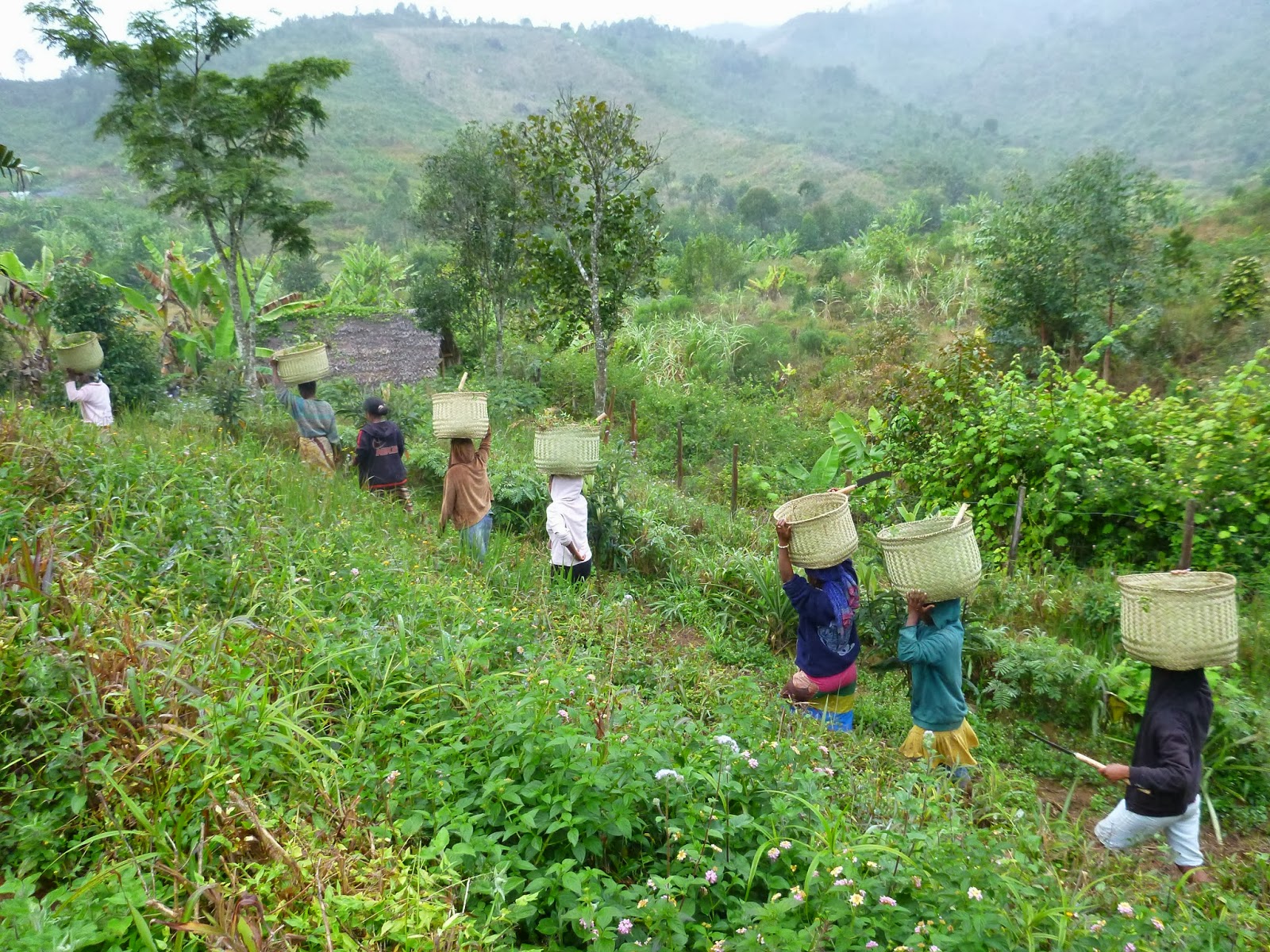
Several months ago, I was approached by a Malagasy man from the capital who was helping a group of women in my village to form a cooperative in which they would produce and sell a medicinal plant that grows in our area of Madagascar. This fellow was apparently the contact point for buyers in Tana. He asked if I could help the women get all of their papers in order to file with the government so that they could become a legal cooperative and sell the raw plant as an association. As a cooperative, the women would have stronger bargaining power for the prices of the plants. This fellow also asked if I could help provide the women with the tools and materials that they would need in order to carry out this project now and for the years ahead. So, thanks to the generosity of so many people, I was able to provide these ladies with everything they needed: shovels, wheelbarrows, scythes, cooking pots for long days in the fields, etc,. The Malagasy name for the plant is "Ampelatsifotra" and it falls under the Desmodium genus. The plant is bought by buyers in Tana, then is sent overseas to be processed into medicines that help to treat such ailments as hepatitis A,B, and C, uteral cancer, and asthma. The cooperative is cultivating the plant in areas surrounding our rain forest that have previously been cut and burned for rice cultivation. The ladies are also starting to grow trees for our reforestation efforts. Here are a few pictures of the work they are doing:


Thanks are particularly in order for the following individuals and groups!!
Mrs. Betty Shelton
Mrs. Sandy Haddad
Mrs. Helyn Keith
Mrs. Anne Spencer
Mrs. Judy McQueen
Mrs. Suzanne Rhea
Mrs. Roberta Parker
Mr. Willie and Mrs. Lucinda Williams
Mr. Rusty and Mrs. Kris Bliss




Thanks are particularly in order for the following individuals and groups!!
Mrs. Betty Shelton
Mrs. Sandy Haddad
Mrs. Helyn Keith
Mrs. Anne Spencer
Mrs. Judy McQueen
Mrs. Suzanne Rhea
Mrs. Roberta Parker
Mr. Willie and Mrs. Lucinda Williams
Mr. Rusty and Mrs. Kris Bliss
The Wesley Room Sunday School Class
The Pairs and Spares Sunday School Class
Tuesday, July 23, 2013
The Things I See, Hear, and Think About When Traveling in Mada
-The Malagasy theory that the reason some cars have the driver side on the right is because those cars were designed by left-handed people.
-The whole making charcoal from eucalyptus process.
-Those tractors on the side of the highway between my site and Moramanga that are in a constant state of (dis)repair.
-A bulldozer in the middle of the highway, that looks quite like it fell off the back of a flatbed tractor-trailer.
-Passing tractor-trailers on blind curves/hills.
-One lane bridges on the national highway that connects the capital to the largest port city in Madagascar.
-Malagasy ripoffs of N'Sync's "Quit Playing Games with My Heart", in which the music is used but has Malagasy rap superimposed on it.
-That it's totally cool, anywhere, anytime, to pick your nose.
-The folks who have set up fruit stands along the highway where the pot holes makes all the cars slow down. Those pot holes get filled in with dirt by children who ask for money for the service they are providing. That dirt then washes out with the rains. Rinse. Repeat.
-The notice painted above the window of the brousse, stating, "We don't carry drunks."
-Sitting next to an old, drunk Malagasy man, who looks strangely similar to the late John Lee Hooker, who is wearing two collared shirts.
-All those goofy sounds that the brousses have for horns, that don't sound like horns but more like whistles or sirens.
-The "Parking Securisé" place, located along a stretch of the highway that begs the questions, "Who wants to park here? And how secure is your picket fence?"
-Lucky Dube, the reggae artist from South Africa, is pronounced "Leaky Deeby". And yes, that annoys me.
-That Malagasy folks look really funny in those wild west sheriff hats that you can buy here for $2. They're everywhere. They even have the star on them. And then you pass police officers, real police officers, who are wearing them too.
-That rain or shine, those rice fields aren't going to bust themselves up.
-How all those clothes that we donate to charity in America, that don't get bought by us at the GoodWill or Samaritan's Purse, end up being sold in bulk to dealers in the developing world, sorted (shirts, pants, undies, etc), packed into huge bales (3ftx3x5), and sold on the streets here for dirt cheap. Yes, that shirt that says, "I'm not getting less hair, I'm getting more head", that you gave to charity, that no one bought, is now being worn by a Malagasy man in my town who has no idea what it means. Same for that "I love Strippers" shirt. Only in the developing world can two people wear rivaling sports team hoodies, sit next to each other, and not think a thing about the other person. And no, that respectable looking man wearing a nice suit does not know that his hat, reading "Club: Men's Power", advertises a pornography company.
-The whole making charcoal from eucalyptus process.
-Those tractors on the side of the highway between my site and Moramanga that are in a constant state of (dis)repair.
-A bulldozer in the middle of the highway, that looks quite like it fell off the back of a flatbed tractor-trailer.
-Passing tractor-trailers on blind curves/hills.
-One lane bridges on the national highway that connects the capital to the largest port city in Madagascar.
-Malagasy ripoffs of N'Sync's "Quit Playing Games with My Heart", in which the music is used but has Malagasy rap superimposed on it.
-That it's totally cool, anywhere, anytime, to pick your nose.
-The folks who have set up fruit stands along the highway where the pot holes makes all the cars slow down. Those pot holes get filled in with dirt by children who ask for money for the service they are providing. That dirt then washes out with the rains. Rinse. Repeat.
-The notice painted above the window of the brousse, stating, "We don't carry drunks."
-Sitting next to an old, drunk Malagasy man, who looks strangely similar to the late John Lee Hooker, who is wearing two collared shirts.
-All those goofy sounds that the brousses have for horns, that don't sound like horns but more like whistles or sirens.
-The "Parking Securisé" place, located along a stretch of the highway that begs the questions, "Who wants to park here? And how secure is your picket fence?"
-Lucky Dube, the reggae artist from South Africa, is pronounced "Leaky Deeby". And yes, that annoys me.
-That Malagasy folks look really funny in those wild west sheriff hats that you can buy here for $2. They're everywhere. They even have the star on them. And then you pass police officers, real police officers, who are wearing them too.
-That rain or shine, those rice fields aren't going to bust themselves up.
-How all those clothes that we donate to charity in America, that don't get bought by us at the GoodWill or Samaritan's Purse, end up being sold in bulk to dealers in the developing world, sorted (shirts, pants, undies, etc), packed into huge bales (3ftx3x5), and sold on the streets here for dirt cheap. Yes, that shirt that says, "I'm not getting less hair, I'm getting more head", that you gave to charity, that no one bought, is now being worn by a Malagasy man in my town who has no idea what it means. Same for that "I love Strippers" shirt. Only in the developing world can two people wear rivaling sports team hoodies, sit next to each other, and not think a thing about the other person. And no, that respectable looking man wearing a nice suit does not know that his hat, reading "Club: Men's Power", advertises a pornography company.
Friday, June 21, 2013
Sounds
I figured one of the best ways to give folks back home a good sense of what it's like to live in a rural Malagasy village of 250 individuals is to describe the aural environment. The things that I hear on a daily basis truly make the reality of the place that I live in. The sounds tell the story of the life, so I'll do my best.
The roosters begin crowing around 4am. Not that I'm usually awake at this hour, but occasionally I am due to the effects of the malaria prophylaxis I take. When one rooster crows at this time of night, all the other ones chime in and for about 2 minutes the entire village is full of the sound of chickens crying the great "I AM". It's like they're saying, "I'm over here. This is my spot. Where are you and your spot?". Every fifteen minutes, another round of crowing will ensue through sunrise, with the time between rounds gradually becoming less and less. In the pre-dawn darkness, the town will begin to wake up. The sound of rice being pounded with mortars and pestles, a dull thud-thud-thud-thud. A truck rolls by on the highway, 30 yards from where I sleep. After the rice is pounded, it gets winnowed, which sounds very similar to a straw broom being swept on a concrete floor. The women will go down to the rocks in the river (which lies just below my house) to scrub their aluminum pots free of the resin left from the firewood from last night's cooking. They use sand and their feet to due this. Another truck rolls by on the highway, failing to miss the potholes with a very loud B-BOOM clankclank. While scouring the pots, the women will often gossip together, usually complaining about their husbands. Somewhere a kid starts crying. Firewood is being chopped to get the morning rice ready. A car goes by on the highway.
The sun begins to rise and the village wakes up. Conversations begin in houses, children are laughing or crying. The roosters still crow. Pigs wake up and grunt, and scream. Palm doors slam against wood frames. Someone has started doing some kind of construction with a hammer. A taxi brousse going to Moramanga, the nearest market town 31km away, honks as it passes through my village, looking for passengers. The ducks and geese have made their way down to the river. The people in my village find it funny when I blow my duck call; whether that's because of how similar it sounds to the ducks or because they're surprised Americans would make such a device, I don't know. I have previously written about my feelings on the sound of geese in the morning, and my opinion has not changed. I wish I could eat more geese if only to help reduce the general noise level that those foul (sp?) animals create. There's also the high pitched singing of the indris in the rainforest about 1km away; they're the largest and most vocal lemurs in Madagascar. Here's a link to a video I took of what the indris sound like in the Maromizaha Forest. Yes, I hear them from my house and, yes, it is awesome.
At around 7:30, the elementary school children will begin to pass by my house on their way to school. Some run by, most yell at their friends or say hello to me as they pass. After the students are in class, the town falls into a bit of a silent spell. Most adults have gone out to their farm fields, the kids are all in class, and the roosters still crow. The sound of chickens (the peeps of chicks, in particular) become kind of like a white noise throughout the day Occasionally, the sounds of the kids yelling out their repetitive lessons will make its way to my house, babies are often crying, and cars goes rolling by on the way. When class starts in the morning, the kids trickle past my house. But when class is over and they are released to go home, they all go running by in a torrent of laughter and screams, happy to be out of school. A rooster crows, a taxi-brousse goes by.
Depending on the time of year, you can also hear different kinds of native species of birds. The "toloho" (Malagasy Coucal) and the "boloky" (Lesser Vasa Parrot) are just two of the different kinds of birds I hear from my house (look them up and give them a listen). I particularly like the toloho.
At the local general store, there is a table set up for playing dominoes. By table I mean a worn out old tire with a hard plastic top put over it. When playing dominoes, the men will often SLAM the pieces down on the table. Intimidation, I guess. But this sound also carries throughout the town, over to my house. The game will also evoke sounds of laughter, arguments, and surprise. POW! Taibe izany! Oi lelena! HAHAHA! Malagasy curse words, ha. Another semitruck passes through the town.
The Malagasy are also incredible whistlers. Not like the carry a tune kind but the get your attention from way far away kind. This is the preferred communication method over long distances and out in the forest.
Come dinner time, it's back to pounding and winnowing rice, back to chopping wood, the chickens are still going at it, and the cars keep passing along the highway.
The highway that passes through my village and the cars, taxi brousses, and semitrucks that travel on it are foreign to most of the people in my town. For them, to travel in a car is a rare occurrence. There's a man in my town who's never traveled farther than Moramanga, 31km away, in his entire life. The highway does nothing for the people in my town except remind them of how immobile their lives are. Taxi brousses are going places that they will never see, places that really aren't very far geographically. But they don't have the money to get there. To get to the capital would cost 8000Ariary (about 4 bucks). And when you're only making about 120,000Ariary (60 bucks) a month, taking a trip out of town just isn't going to happen. The goods that the semitrucks are carrying will likely never come to my town, those goods are a part of the "haves" economy. The world flies by my village. And all it can do is watch it. And try to stay out of the way.
The roosters begin crowing around 4am. Not that I'm usually awake at this hour, but occasionally I am due to the effects of the malaria prophylaxis I take. When one rooster crows at this time of night, all the other ones chime in and for about 2 minutes the entire village is full of the sound of chickens crying the great "I AM". It's like they're saying, "I'm over here. This is my spot. Where are you and your spot?". Every fifteen minutes, another round of crowing will ensue through sunrise, with the time between rounds gradually becoming less and less. In the pre-dawn darkness, the town will begin to wake up. The sound of rice being pounded with mortars and pestles, a dull thud-thud-thud-thud. A truck rolls by on the highway, 30 yards from where I sleep. After the rice is pounded, it gets winnowed, which sounds very similar to a straw broom being swept on a concrete floor. The women will go down to the rocks in the river (which lies just below my house) to scrub their aluminum pots free of the resin left from the firewood from last night's cooking. They use sand and their feet to due this. Another truck rolls by on the highway, failing to miss the potholes with a very loud B-BOOM clankclank. While scouring the pots, the women will often gossip together, usually complaining about their husbands. Somewhere a kid starts crying. Firewood is being chopped to get the morning rice ready. A car goes by on the highway.
The sun begins to rise and the village wakes up. Conversations begin in houses, children are laughing or crying. The roosters still crow. Pigs wake up and grunt, and scream. Palm doors slam against wood frames. Someone has started doing some kind of construction with a hammer. A taxi brousse going to Moramanga, the nearest market town 31km away, honks as it passes through my village, looking for passengers. The ducks and geese have made their way down to the river. The people in my village find it funny when I blow my duck call; whether that's because of how similar it sounds to the ducks or because they're surprised Americans would make such a device, I don't know. I have previously written about my feelings on the sound of geese in the morning, and my opinion has not changed. I wish I could eat more geese if only to help reduce the general noise level that those foul (sp?) animals create. There's also the high pitched singing of the indris in the rainforest about 1km away; they're the largest and most vocal lemurs in Madagascar. Here's a link to a video I took of what the indris sound like in the Maromizaha Forest. Yes, I hear them from my house and, yes, it is awesome.
At around 7:30, the elementary school children will begin to pass by my house on their way to school. Some run by, most yell at their friends or say hello to me as they pass. After the students are in class, the town falls into a bit of a silent spell. Most adults have gone out to their farm fields, the kids are all in class, and the roosters still crow. The sound of chickens (the peeps of chicks, in particular) become kind of like a white noise throughout the day Occasionally, the sounds of the kids yelling out their repetitive lessons will make its way to my house, babies are often crying, and cars goes rolling by on the way. When class starts in the morning, the kids trickle past my house. But when class is over and they are released to go home, they all go running by in a torrent of laughter and screams, happy to be out of school. A rooster crows, a taxi-brousse goes by.
Depending on the time of year, you can also hear different kinds of native species of birds. The "toloho" (Malagasy Coucal) and the "boloky" (Lesser Vasa Parrot) are just two of the different kinds of birds I hear from my house (look them up and give them a listen). I particularly like the toloho.
At the local general store, there is a table set up for playing dominoes. By table I mean a worn out old tire with a hard plastic top put over it. When playing dominoes, the men will often SLAM the pieces down on the table. Intimidation, I guess. But this sound also carries throughout the town, over to my house. The game will also evoke sounds of laughter, arguments, and surprise. POW! Taibe izany! Oi lelena! HAHAHA! Malagasy curse words, ha. Another semitruck passes through the town.
The Malagasy are also incredible whistlers. Not like the carry a tune kind but the get your attention from way far away kind. This is the preferred communication method over long distances and out in the forest.
Come dinner time, it's back to pounding and winnowing rice, back to chopping wood, the chickens are still going at it, and the cars keep passing along the highway.
The highway that passes through my village and the cars, taxi brousses, and semitrucks that travel on it are foreign to most of the people in my town. For them, to travel in a car is a rare occurrence. There's a man in my town who's never traveled farther than Moramanga, 31km away, in his entire life. The highway does nothing for the people in my town except remind them of how immobile their lives are. Taxi brousses are going places that they will never see, places that really aren't very far geographically. But they don't have the money to get there. To get to the capital would cost 8000Ariary (about 4 bucks). And when you're only making about 120,000Ariary (60 bucks) a month, taking a trip out of town just isn't going to happen. The goods that the semitrucks are carrying will likely never come to my town, those goods are a part of the "haves" economy. The world flies by my village. And all it can do is watch it. And try to stay out of the way.
Saturday, April 27, 2013
What are you doing to STOMP out Malaria in Africa?
As Peace Corps Volunteers, we team up with the President's Malaria Initiative to help end malaria in Madagascar. Here's a bit of info on the malaria situation here in Madagascar.
At a Glance: Madagascar
Population (2012): 22.6 million
Population at risk of malaria
(2010): 100%
Estimated annual malaria deaths/100,000 population (2008): 8
Under-five mortality rate (2009): 72/1,000 live births, or approximately 1 in 14 children die before their fifth birthday4
Background
Malaria is a major health problem in Madagascar, and while its epidemiology varies considerably in different regions of the country, the entire population is considered to be at risk for the disease. On the east coast, transmission is stable and perennial, and the west coast has one long, rainy transmission season and a brief dry season. Almost one-third of the Central Highlands is above 1,500 meters elevation, where malaria transmission rarely occurs.
Malaria cases and deaths reported through the national health management information system have declined over the period of 2003–2009, but malaria remains a leading cause of deaths for children under five. Following the political crisis and coup d’état in March 2009, all U.S. Government support to the current government, from the central Ministry of Health to the primary care health facility level, was suspended until a freely and fairly elected government is in place. The fiscal year (FY) 2012 Malaria Operational Plan was developed based on the assumption that U.S. Government suspensions will remain in place.
The President’s Malaria Initiative (PMI)
Madagascar is one of 19 focus countries benefiting from the President’s Malaria Initiative (PMI), which is led by the U.S. Agency for International Development and implemented together with the U.S. Centers for Disease Control and Prevention. PMI was launched in 2005 as a five-year (FY 2006–2010), $1.265 billion expansion of U.S. Government resources to reduce the burden of malaria and help relieve poverty on the African continent. The 2008 Lantos-Hyde Act authorized an extension of PMI funding through FY 2013. With congressional authorization and the subsequent launch of the U.S. Government’s Global Health Initiative, PMI’s goal was expanded to achieve Africa-wide impact by halving the burden of malaria in 70 percent of the at-risk populations on the continent (i.e., approximately 450 million residents), thereby removing malaria as a major public health problem and promoting development throughout the African region.
To reach its goal, PMI works with national malaria control programs and coordinates its activities with national and international partners, including the Roll Back Malaria Partnership; The Global Fund to Fight AIDS, Tuberculosis and Malaria; the World Health Organization (WHO); the World Bank; the U.K. Department for International Development; numerous nongovernmental organizations, including faith-based and community groups; and the private sector.
Friday, March 15, 2013
A Few Moments in My Life
I awoke one night around 1:30am. Not sure if I was truly awake or not, I heard singing in my small Malagasy village. This doesn't happen on a regular occurrence. In fact, this was the first time I had ever woken up in the middle of the night to hear much of anything going on in my town. People close their houses when it gets dark and are all asleep by around 9:30pm because there is no electricity for lights and the few folks who have generators only run them on special occasions. Thus, I was perplexed as to why a group of people would be awake in the dead of night and singing as if it were a Sunday worship service. I sat up in my bed and wondered how to address the situation. Because, obviously, I had to do something with such a strange event happening. I remembered the "sleep-together" that had happened several months ago when a friend of mine's 2 year old daughter had died and many folks from the community went to his family's house and spent time with them, ate with them, drank (a lot) with them, and played cards and dominoes with them through the night. I feared that something similar may be happening in my community again. So, I donned my blue jeans, UNC-Asheville t-shirt, flipflops, and a hoodie. I put my headlamp on and left my house to investigate the late night chorus. When I reached the main road, only about 20 yards from my house, I encountered one of the store owners in my town and asked him what the singing was all about. "Misy faty," he said. Someone is dead. "Iza?", I asked him. He told me that Dada Gil had died. Gilbert, better known as Dada Gil, was not old by American standards. Not quite 60, was most people's guess. I had played dominoes with him many times and shared rum with him from time to time. He struck me as a classy man; he always wore a white and blue striped sports coat that reminded me of the train engineer overalls I used to wear when I was a kid. A Ben Hogan style cap was always graced the top of his head. He had cloudy eyes, which I guess made him seem older than he actually was; they made him seem wiser too. He had been sick with something for weeks, I don't know what. After returning from getting medicine in Moramanga earlier that day, he found himself unable to breath and died early in the evening. As per Malagasy tradition, the whole community would come to his house to attend the wake (I guess we would call it) throughout the night, where the women of the community would be drinking taoka gasy and singing hymns; and the men would be drinking taoka gasy and playing cards and dominoes, and Dada Gil would be lying in his bed with a sheet over his body, and candles around his head. This was the second "sleep together" I had attended, and I don't I'll ever get used to them. They're so weird, cool, sad, depressing, fun, and interesting. You never really know what to feel.
I ate a tenrec the other day. Watch the BBC series on Madagascar and you'll see a nice little segment about them. They're kinda of like hedgehogs with more color. I went out to weed the rice fields that I and my friend, Tahiry, are currently working on. We should be harvesting around the end of April/early May. When we got to the path that leads to our fields, I noticed that there was a dead tenrec lying in the trail. Tahiry asked me, "Efa nihinana trandraka ve ianao?". I answered him, "No, I've never eaten tenrec before, nor have I ever seen one". He told me it was "really good"! I asked him how long he thought this one had been dead. "Vao maty tamin'ny maraina izy," he suggested. Considering that it had just been killed by who-knows-what during the morning, he proposed that we have it for lunch. Why not, right? So we did the work in the fields we had come to do, and when we had finished, picked up the dead tenrec to be cooked for laoka anto'andro, "that which you eat with rice during the middle of the day". It smelled ok. It tasted ok. But the tenrec is pretty much the equivalent of the North American possum. Kind of strange to think about eating such an animal. After finishing it, I was glad to have tried it and could now say that I'd eaten one. It had a very gamey taste to it. However, about an hour later, my burps began to have strange taste to them. Have you ever smelled a dead skunk that's been hit on a highway? That's what my belches tasted like. So, for future advice for those who may be tempted to eat a tenrec, be advised: it may taste OK doing down, but the "Sonic the Hedgehog" of Madagascar makes your burps taste like roadkill. Enjoy.
I had a meeting with one of my partner organizations in Moramanga earlier this week. The secretary of the association, Mr. Franklin, had invited me attend the meeting and had asked if I would bring a certain picture of me and him that had been taken at a previous meeting in the coastal city of Tamatave. In the picture, we posed shaking hands. Always happy to attend official meetings, I came to Moramanga on Tuesday, wondering what the content of the meeting was going to be. The meeting began and I quickly realized that I had been duped. Conservation International had initiated a project about a year ago doing work with pig raising and ginger growing. However, my community's branch of this organization was not a part of this project, making my attendance of the meeting irrelevant. The project doesn't affect my town or my work. Having been here for a year, I only laughed after realizing that my attendance at the meeting was only so that Mr. Franklin could get the picture from me and get it developed. This is the indirectness of the Malagasy culture. Yeah, I would have preferred him to just ask me if we could get the picture developed in Moramanga sometime for him, but I wasn't angry or perturbed that he'd gone the round-about way of getting it. It just made me laugh.
I've taken up playing dominoes with the local men in my town. Women don't play. I didn't make the rules or the cultural norms, sorry. But I find playing dominoes is another way to further integrate into my community. I've learned a lot of new, very applicable words (and a few dirty ones), my ability to count in French has gotten much better (though I tend to count in English in my head then announce the sum in French), and the local men have come to see me more as just one the guys in town, not just the "vazaha", though I definitely am still that. The dominoes table is set up in a little shelter made of wood and palm leaf along the highway next to one of the busier stores in town. Previously, this building was use to keep sacks of charcoal out of the rain. The table itself is a flat sheet of old plastic-like material, set on an old tire. The seats are logs and stones. The dominoes themselves are perennially dirty as they fall off the table quite often when the Malagasy slam the pieces down on the not-so-sturdy-table, an action meant to display the superiority of the domino they are playing to those that the other players have in their hands. Their hands are also often very dirty as well, most of them being charcoal makers. But, such is the way of it. We put 200 Ariary on each game, if you win you make 400 Ariary. 200 Ariary is the approximate equivalent of 10 cents in the United States. 10 cents can actually get you a quite few things at the local store: 2 cigarettes, 4 small packs of peanuts, 2 cookies, 2 tomatoes, 4 small onions, some cooking oil, a little kerosene for your lamp, or even a double shot of Malagasy moonshine. Making 400 Ariary (about 20 cents) is a nice little pick up at the end of the day for most of the men in my town. I lose a lot. Most of the time, I play, enjoy myself playing a game with the guys of my village, and lose 200 Ariary. Being the guy from who-knows-where across the seas of the world, they aren't expecting me to win. I don't expect myself to win, I've never been much of a dominoes player anyway. But sometimes, I don't lose. And when I don't lose, the guys who are watching are so surprised I get a full round of fist bumps. The money I do make I use to buy cigarettes or a small snack for the guys I beat. But I'm starting to get good, well, better than I was. But it doesn't really matter to me so long as the guys keep letting me play with them and be just another guy in town, killing time and hanging around.
My MOM will be here in Madagascar in two week!!! I can't wait to meet her at the airport in Antananarivo and show her the life I live here. Bring your camera, Mama.
Until next time, I hope everyone enjoys NCAA March Madness. Tennessee's playing today (3/15) to get into the semi's of the SEC tourney. Go VOLS.
Amin'ny manaraka indray e!
James
I ate a tenrec the other day. Watch the BBC series on Madagascar and you'll see a nice little segment about them. They're kinda of like hedgehogs with more color. I went out to weed the rice fields that I and my friend, Tahiry, are currently working on. We should be harvesting around the end of April/early May. When we got to the path that leads to our fields, I noticed that there was a dead tenrec lying in the trail. Tahiry asked me, "Efa nihinana trandraka ve ianao?". I answered him, "No, I've never eaten tenrec before, nor have I ever seen one". He told me it was "really good"! I asked him how long he thought this one had been dead. "Vao maty tamin'ny maraina izy," he suggested. Considering that it had just been killed by who-knows-what during the morning, he proposed that we have it for lunch. Why not, right? So we did the work in the fields we had come to do, and when we had finished, picked up the dead tenrec to be cooked for laoka anto'andro, "that which you eat with rice during the middle of the day". It smelled ok. It tasted ok. But the tenrec is pretty much the equivalent of the North American possum. Kind of strange to think about eating such an animal. After finishing it, I was glad to have tried it and could now say that I'd eaten one. It had a very gamey taste to it. However, about an hour later, my burps began to have strange taste to them. Have you ever smelled a dead skunk that's been hit on a highway? That's what my belches tasted like. So, for future advice for those who may be tempted to eat a tenrec, be advised: it may taste OK doing down, but the "Sonic the Hedgehog" of Madagascar makes your burps taste like roadkill. Enjoy.
I had a meeting with one of my partner organizations in Moramanga earlier this week. The secretary of the association, Mr. Franklin, had invited me attend the meeting and had asked if I would bring a certain picture of me and him that had been taken at a previous meeting in the coastal city of Tamatave. In the picture, we posed shaking hands. Always happy to attend official meetings, I came to Moramanga on Tuesday, wondering what the content of the meeting was going to be. The meeting began and I quickly realized that I had been duped. Conservation International had initiated a project about a year ago doing work with pig raising and ginger growing. However, my community's branch of this organization was not a part of this project, making my attendance of the meeting irrelevant. The project doesn't affect my town or my work. Having been here for a year, I only laughed after realizing that my attendance at the meeting was only so that Mr. Franklin could get the picture from me and get it developed. This is the indirectness of the Malagasy culture. Yeah, I would have preferred him to just ask me if we could get the picture developed in Moramanga sometime for him, but I wasn't angry or perturbed that he'd gone the round-about way of getting it. It just made me laugh.
I've taken up playing dominoes with the local men in my town. Women don't play. I didn't make the rules or the cultural norms, sorry. But I find playing dominoes is another way to further integrate into my community. I've learned a lot of new, very applicable words (and a few dirty ones), my ability to count in French has gotten much better (though I tend to count in English in my head then announce the sum in French), and the local men have come to see me more as just one the guys in town, not just the "vazaha", though I definitely am still that. The dominoes table is set up in a little shelter made of wood and palm leaf along the highway next to one of the busier stores in town. Previously, this building was use to keep sacks of charcoal out of the rain. The table itself is a flat sheet of old plastic-like material, set on an old tire. The seats are logs and stones. The dominoes themselves are perennially dirty as they fall off the table quite often when the Malagasy slam the pieces down on the not-so-sturdy-table, an action meant to display the superiority of the domino they are playing to those that the other players have in their hands. Their hands are also often very dirty as well, most of them being charcoal makers. But, such is the way of it. We put 200 Ariary on each game, if you win you make 400 Ariary. 200 Ariary is the approximate equivalent of 10 cents in the United States. 10 cents can actually get you a quite few things at the local store: 2 cigarettes, 4 small packs of peanuts, 2 cookies, 2 tomatoes, 4 small onions, some cooking oil, a little kerosene for your lamp, or even a double shot of Malagasy moonshine. Making 400 Ariary (about 20 cents) is a nice little pick up at the end of the day for most of the men in my town. I lose a lot. Most of the time, I play, enjoy myself playing a game with the guys of my village, and lose 200 Ariary. Being the guy from who-knows-where across the seas of the world, they aren't expecting me to win. I don't expect myself to win, I've never been much of a dominoes player anyway. But sometimes, I don't lose. And when I don't lose, the guys who are watching are so surprised I get a full round of fist bumps. The money I do make I use to buy cigarettes or a small snack for the guys I beat. But I'm starting to get good, well, better than I was. But it doesn't really matter to me so long as the guys keep letting me play with them and be just another guy in town, killing time and hanging around.
My MOM will be here in Madagascar in two week!!! I can't wait to meet her at the airport in Antananarivo and show her the life I live here. Bring your camera, Mama.
Until next time, I hope everyone enjoys NCAA March Madness. Tennessee's playing today (3/15) to get into the semi's of the SEC tourney. Go VOLS.
Amin'ny manaraka indray e!
James
Monday, March 4, 2013
One Year
First off, some shout outs are indeed in order:
Steve and Carol: Thank you guys so much for the Christmas package! Just when I thought my Christmas was over, I had another package waiting for me at the post office. You guys are great! And I loved the card with dogs on it. Good looking dogs are a rare sight for me these days and you guys sure have an eye for them. Love y'all!
Barbara, Baily, Ninh, Amanda, and Ellen: You guys are hilarious. I open your package and get vomited on by the quantity of Starburst flowing out of it. I particularly liked the list of "first world problems" that I don't have to deal with here (i.e.: iPad vs. Macbook). However, there are NEVER enough outlets in this country!!! Thank you guys so much for sending the love. Pile all your money together and send yourselves over here. Miss you guys.
Holmes Family: Much love to Pat, Jill, Jeb, and Jessie for thinking of me during the holidays! Miss you guys a lot and can't wait to see you when I get back.
In case you don't remember, I left the USA just over one year ago. I filled out a bunch of paperwork for the application process, said goodbye to family and dear friends, got on a plane, became fast friends with a group of random, kinda weird, and very good hearted fellow PCVs. Then, we all got on a plane bound for an island in the Indian Ocean that about which many Americans ask, "Are there people in Madagascar?". Yes, there are people here. More than 20 million of them. And they are Malagasy people. Just Gasy (GAH-see) for short. And they are amongst the world's most impoverished peoples, both in their lack of income and in the lack of opportunity for improving their lives within the borders of their coasts. But they are also a people full of love as well. Since the day I was welcomed into the home of a random Gasy family during the homestay portion of my training a year ago, to the nightly conversations I have with my Gasy best friend at my site, Tahiry, I have become friends with the Malagasy. Yeah, they're weird. They're ignorant of a lot of things going on in the world ("Oh, you're from the Etazonia? That's close to Brazil and France, gotcha.") But I love em. And my Mama is coming in a little more than 3 weeks!!!! I can't wait to show this country to someone from back home and to see this country again through fresh eyes. It's strange to think that everyone that I have seen in the past year has only been in my life for that amount of time. So come on, Mama, can't wait for you to see this weird, crazy, beautiful, disgusting, fun, boring, loud, stinky, amazing place I live in.
Also, anyone else who wants to come (and can afford it) is always more than welcome to make their across the world and check this place out. Come anytime, we're always open.
Also, NO MORE BIG PACKAGES. Thanks sooooo much to everyone who sent me their love in a box! But please stop sending them. I am well stocked on everything I need and if I ain't got it, I don't need it. You guys are so awesome for sending so much great stuff. It also costs me 7 dollars (14000 Ariary) everytime I pick up a big package at the post office (plus holding fees if it takes me a while to get there). And on a $200/month budget, that can add up. So, again, thank you thank you thank you thank you! Now stop it stop it stop it stop it stop it stop it. Small things are fine, just not the boxes! You guys are great.
Take care everyone.
One year down.
One year to go.
See ya again before we know it.
James
Steve and Carol: Thank you guys so much for the Christmas package! Just when I thought my Christmas was over, I had another package waiting for me at the post office. You guys are great! And I loved the card with dogs on it. Good looking dogs are a rare sight for me these days and you guys sure have an eye for them. Love y'all!
Barbara, Baily, Ninh, Amanda, and Ellen: You guys are hilarious. I open your package and get vomited on by the quantity of Starburst flowing out of it. I particularly liked the list of "first world problems" that I don't have to deal with here (i.e.: iPad vs. Macbook). However, there are NEVER enough outlets in this country!!! Thank you guys so much for sending the love. Pile all your money together and send yourselves over here. Miss you guys.
Holmes Family: Much love to Pat, Jill, Jeb, and Jessie for thinking of me during the holidays! Miss you guys a lot and can't wait to see you when I get back.
In case you don't remember, I left the USA just over one year ago. I filled out a bunch of paperwork for the application process, said goodbye to family and dear friends, got on a plane, became fast friends with a group of random, kinda weird, and very good hearted fellow PCVs. Then, we all got on a plane bound for an island in the Indian Ocean that about which many Americans ask, "Are there people in Madagascar?". Yes, there are people here. More than 20 million of them. And they are Malagasy people. Just Gasy (GAH-see) for short. And they are amongst the world's most impoverished peoples, both in their lack of income and in the lack of opportunity for improving their lives within the borders of their coasts. But they are also a people full of love as well. Since the day I was welcomed into the home of a random Gasy family during the homestay portion of my training a year ago, to the nightly conversations I have with my Gasy best friend at my site, Tahiry, I have become friends with the Malagasy. Yeah, they're weird. They're ignorant of a lot of things going on in the world ("Oh, you're from the Etazonia? That's close to Brazil and France, gotcha.") But I love em. And my Mama is coming in a little more than 3 weeks!!!! I can't wait to show this country to someone from back home and to see this country again through fresh eyes. It's strange to think that everyone that I have seen in the past year has only been in my life for that amount of time. So come on, Mama, can't wait for you to see this weird, crazy, beautiful, disgusting, fun, boring, loud, stinky, amazing place I live in.
Also, anyone else who wants to come (and can afford it) is always more than welcome to make their across the world and check this place out. Come anytime, we're always open.
Also, NO MORE BIG PACKAGES. Thanks sooooo much to everyone who sent me their love in a box! But please stop sending them. I am well stocked on everything I need and if I ain't got it, I don't need it. You guys are so awesome for sending so much great stuff. It also costs me 7 dollars (14000 Ariary) everytime I pick up a big package at the post office (plus holding fees if it takes me a while to get there). And on a $200/month budget, that can add up. So, again, thank you thank you thank you thank you! Now stop it stop it stop it stop it stop it stop it. Small things are fine, just not the boxes! You guys are great.
Take care everyone.
One year down.
One year to go.
See ya again before we know it.
James
Sunday, March 3, 2013
The Law is a Human Institution
About two months ago, I returned back to my site after a very nice Christmas vacation in Diego-Suarez, the northernmost city in Madagascar. It was great to be back where I was integrated into the Malagasy society where folks are used to seeing me and aren't surprised at the fact of seeing a white person who knows how to speak their language. My best friend at site, Tahiry, came over and caught me up what was going with him. He informed me that this sister's daughter, his niece of 12 years old, had disappeared from her house just before Christmas and had not been heard of since (two weeks at the time). He asked me if he could borrow my bike so that he could go to Moramanga, the closest banking town and where his sister's family lives, and help with the police investigation and help in the search for his niece. Sorry Peace Corps, I know we're not supposed to do it, but I let him borrow my bike for two days. He came back, having had no luck looking for the girl. He and his family had filed all the necessary paper work with the police and had asked around the town for any information they could gather, finding none. The girl's younger sister claimed that she saw her getting into a white car with a bunch of people in it. I asked Tahiry if this kind of thing happened often in Madagascar. He told me that child disappearances were actually a fairly common experience on the island, mostly from kidnappings. This brought to mind stories of kidnappings in Mexico, where people are held for ransom. When asked why children were being kidnapped in Madagascar (this country being extremely poor, making kidnapping for ransom not a very lucrative practice), Tahiry told me that children are often kidnapped by organ thieves. There are often reports of bodies found, organs missing. A grim outlook for a family with a missing child. Asked what the police would do about the situation, I was told that pictures of the girl would be put up at police stations in the region, with little hope of actually finding the girl. Police stations do not have computer systems as well (still in the typewriter age). Now, the girl has been missing for more than 2 months, without a word or lead as to where she may be and little hope of the law enforcement system being of any help.
About 3 weeks ago, several gentleman from community were released from jail after being accused of cutting areas of eucalyptus forest owned by a woman who lives in Antananarivo. The idea of "innocent until proven guilty" is either loosely enforced or non-existent in Madagascar. The woman who owns the trees simply brought forth the accusation to the Gendarmerie that these certain gentlemen had committed this crime, and they were duly arrested and held in prison for a month and a half without trial. There trial date was finally held and the proper fines (bribes?) were payed to the court officials so that they could be released from jail. No evidence was ever found in favor of the plaintiff.
There is a scene in the Cohen Brothers' film "O Brother Where Art Thou?", where Everett and his companions are about to be hung by the sheriff and Everett says, "It ain't the law!". The sheriff replies, "The law? The law is a human institution."Brings to mind that earlier in the movie, Tommy Johnson describes his encounter with devil, to whom he had sold his soul, and describes the devil's appearance as being very similar to that of the sheriff. Indeed, the sheriff's character may have indeed been the devil. However, the law is a human institution, free to be influenced by passion, money, power, and malaise.
About 3 weeks ago, several gentleman from community were released from jail after being accused of cutting areas of eucalyptus forest owned by a woman who lives in Antananarivo. The idea of "innocent until proven guilty" is either loosely enforced or non-existent in Madagascar. The woman who owns the trees simply brought forth the accusation to the Gendarmerie that these certain gentlemen had committed this crime, and they were duly arrested and held in prison for a month and a half without trial. There trial date was finally held and the proper fines (bribes?) were payed to the court officials so that they could be released from jail. No evidence was ever found in favor of the plaintiff.
There is a scene in the Cohen Brothers' film "O Brother Where Art Thou?", where Everett and his companions are about to be hung by the sheriff and Everett says, "It ain't the law!". The sheriff replies, "The law? The law is a human institution."Brings to mind that earlier in the movie, Tommy Johnson describes his encounter with devil, to whom he had sold his soul, and describes the devil's appearance as being very similar to that of the sheriff. Indeed, the sheriff's character may have indeed been the devil. However, the law is a human institution, free to be influenced by passion, money, power, and malaise.
Friday, January 11, 2013
Holidays
A quick shout out to folks who sent me packages!!
Benjamin: CUZ! Thanks so much for the Christmas package buddy. It was great getting all those books and goodies all the way from Georgia to this island in the Indian Ocean. Merry Christmas Buddy!!!
Joffrions: You guys rock. And no, I do not yet have, nor have I yet read, "Lords and Lemurs" and very much look forward to digging into it. Also, the Blue Ridge Parkway Calendar rocks! Helps remind me of the differences in climate throughout the year as compared to Madagascar (it's steaming hot and wet hear now whereas there's snow and ice on Grandfather Mountain). Merry Christmas to you!!
Mawmaw et al: You know I love you and always love the packages I get from you. The cookies were slightly crumbled but still DELISH. And I look forward to getting into the books by Garrison Keiler and the other about the Holocaust survivor. Merry Christmas and I love you so much!!!!
I returned to site about a week ago after a fantastic vacation around this huge island. The Friday before Christmas, I traveled back to the old Anjozoro (where I lived during my first month on the island) and I visited my host family there for one day. It was great seeing them and getting to actually be able to converse with them. My skills in Malagasy are greatly improved now compared to when I first got here (when I'm sure I sounded like a cave man) so we were actually able to have decent conversation. After that, I left Antananarivo on a Saturday afternoon and arrived in Antsiranana (Diego Suarez) on a Sunday afternoon. That's right, a 24 hour taxi-brousse ride from the capitol all the way to the northern-most tip of Madagascar. There were about 20 volunteers who went there to celebrate Christmas and it was amazing. Our first day there, Christmas Eve, we all hired a boat to take us out to what are called the Emerald Islands. It took about an hour and a half to arrive there. The boat ride was fantastic, sailing through the blue-green waters of the Diego bay, which also provided us with a viewing of the Nosy Lonja (Sugarload Island), a very famous natural landmark in the bay. Along the way, we picked up our lunch from a spear-fisherman, a stringer full of fish freshly caught/speared. We left the bay for the open waters of the Indian Ocean and arrived at the Emerald Islands, where the sand was white and the waters were, truly, emerald green. There were several palm bungalows that helped to provide us with shade between swimming and sunning (though I turned down the sunning). We also had lunch of rice, crab, and the fish we had picked up on route (cooked by our friendly Malagasy guides). AND we even sang some Christmas carols. To say the least, by the time we arrived back in Diego in the late afternoon, we were all fairly exhausted from beaching and sunning all day (though I didn't get a sunburn, WOOHOO!), that we had dinner and called it an early night. On Christmas Day, we went to one of the finer hotels in Diego and got to use their pool (for a fee, which included a very nice lunch). It was real interesting spending Christmas Eve and Day beaching and pooling in very hot weather (definitely a first for me). Diego is a great city, very different than Antananarivo. Very clean, good roads, Tuk-tuks (moto-taxis that carry passengers for 25 cents wherever your going, and taxis for 50 cents the same), GREAT food (fried shrimp!!!), and cool architecture (Google: Antsiranana or Diego Suarez). A very Merry Christmas indeed.
For New Years, I travelled back to Antananarivo (it's just fun typing that name, isn't it?). I bought a suit on the streets for $7 and a belt with a silver electric guitar buckle with a spinning dollar sign emblem for $1.50. Gotta make sure to look good for New Years, ya know? We had a great house party at our Malaria Initiative Coordinator's house then, for the midnight countdown, moved to downtown Tana at a nice place called Planet Terrace. Since there was no real countdown led by Malagasy, we wound up having two, unsynchronised countdowns to midnight. Ah well. So much fun though. Happy New Years!!!
Site has been slow but good since returning from vacation. I got visited by my good friend Nick for two days this week (thanks for the double IPA beer from the states!!!). I am planning on traveling to Antsirabe in the coming weeks/months to start getting more information on the cattle market. Rice is growing well. We just got visited by THE Dr. Patricia Wright (aka Mrs. Save the Forests of Madagascar) who is looking into getting us some help from her friends in high places (WOOHOO!).
Rat update: I had them under control. I even quit counting because there weren't too many to worry about anymore. I'm guessing the current number is around 15-18 that I have personally killed. However, since returning from my holiday vacation, they have taken over my house. They have eaten through the wood of my house to create their own personal entrances everywhere. They ate my rice winnower. They my oil and petrol bottles. They ate my spices. This is war. I tried being fair. I let them bring the battle to me for too long. Time to show them what America can do. Stay tuned...
Happy 2013 to everyone back home! This is my full year, from beginning to end, in Madagascar. I've been here for more than 10 months already. Sometimes the time seems to drag, but it flies most of the time. I can't believe I'll be marking a year in a little less than 2 months. I guess I'll be home before I know it. See you guys next year!!
Love,
James
Benjamin: CUZ! Thanks so much for the Christmas package buddy. It was great getting all those books and goodies all the way from Georgia to this island in the Indian Ocean. Merry Christmas Buddy!!!
Joffrions: You guys rock. And no, I do not yet have, nor have I yet read, "Lords and Lemurs" and very much look forward to digging into it. Also, the Blue Ridge Parkway Calendar rocks! Helps remind me of the differences in climate throughout the year as compared to Madagascar (it's steaming hot and wet hear now whereas there's snow and ice on Grandfather Mountain). Merry Christmas to you!!
Mawmaw et al: You know I love you and always love the packages I get from you. The cookies were slightly crumbled but still DELISH. And I look forward to getting into the books by Garrison Keiler and the other about the Holocaust survivor. Merry Christmas and I love you so much!!!!
I returned to site about a week ago after a fantastic vacation around this huge island. The Friday before Christmas, I traveled back to the old Anjozoro (where I lived during my first month on the island) and I visited my host family there for one day. It was great seeing them and getting to actually be able to converse with them. My skills in Malagasy are greatly improved now compared to when I first got here (when I'm sure I sounded like a cave man) so we were actually able to have decent conversation. After that, I left Antananarivo on a Saturday afternoon and arrived in Antsiranana (Diego Suarez) on a Sunday afternoon. That's right, a 24 hour taxi-brousse ride from the capitol all the way to the northern-most tip of Madagascar. There were about 20 volunteers who went there to celebrate Christmas and it was amazing. Our first day there, Christmas Eve, we all hired a boat to take us out to what are called the Emerald Islands. It took about an hour and a half to arrive there. The boat ride was fantastic, sailing through the blue-green waters of the Diego bay, which also provided us with a viewing of the Nosy Lonja (Sugarload Island), a very famous natural landmark in the bay. Along the way, we picked up our lunch from a spear-fisherman, a stringer full of fish freshly caught/speared. We left the bay for the open waters of the Indian Ocean and arrived at the Emerald Islands, where the sand was white and the waters were, truly, emerald green. There were several palm bungalows that helped to provide us with shade between swimming and sunning (though I turned down the sunning). We also had lunch of rice, crab, and the fish we had picked up on route (cooked by our friendly Malagasy guides). AND we even sang some Christmas carols. To say the least, by the time we arrived back in Diego in the late afternoon, we were all fairly exhausted from beaching and sunning all day (though I didn't get a sunburn, WOOHOO!), that we had dinner and called it an early night. On Christmas Day, we went to one of the finer hotels in Diego and got to use their pool (for a fee, which included a very nice lunch). It was real interesting spending Christmas Eve and Day beaching and pooling in very hot weather (definitely a first for me). Diego is a great city, very different than Antananarivo. Very clean, good roads, Tuk-tuks (moto-taxis that carry passengers for 25 cents wherever your going, and taxis for 50 cents the same), GREAT food (fried shrimp!!!), and cool architecture (Google: Antsiranana or Diego Suarez). A very Merry Christmas indeed.
For New Years, I travelled back to Antananarivo (it's just fun typing that name, isn't it?). I bought a suit on the streets for $7 and a belt with a silver electric guitar buckle with a spinning dollar sign emblem for $1.50. Gotta make sure to look good for New Years, ya know? We had a great house party at our Malaria Initiative Coordinator's house then, for the midnight countdown, moved to downtown Tana at a nice place called Planet Terrace. Since there was no real countdown led by Malagasy, we wound up having two, unsynchronised countdowns to midnight. Ah well. So much fun though. Happy New Years!!!
Site has been slow but good since returning from vacation. I got visited by my good friend Nick for two days this week (thanks for the double IPA beer from the states!!!). I am planning on traveling to Antsirabe in the coming weeks/months to start getting more information on the cattle market. Rice is growing well. We just got visited by THE Dr. Patricia Wright (aka Mrs. Save the Forests of Madagascar) who is looking into getting us some help from her friends in high places (WOOHOO!).
Rat update: I had them under control. I even quit counting because there weren't too many to worry about anymore. I'm guessing the current number is around 15-18 that I have personally killed. However, since returning from my holiday vacation, they have taken over my house. They have eaten through the wood of my house to create their own personal entrances everywhere. They ate my rice winnower. They my oil and petrol bottles. They ate my spices. This is war. I tried being fair. I let them bring the battle to me for too long. Time to show them what America can do. Stay tuned...
Happy 2013 to everyone back home! This is my full year, from beginning to end, in Madagascar. I've been here for more than 10 months already. Sometimes the time seems to drag, but it flies most of the time. I can't believe I'll be marking a year in a little less than 2 months. I guess I'll be home before I know it. See you guys next year!!
Love,
James
Friday, December 7, 2012
Holidays and Lychees
It's been a while, yeah I know. I hope everyone is doing great and is in the holiday spirit. I'm doing great here on the Mad Island.
Our regional volunteer meeting was held in Tamatave at the beginning of November. It was great to see all the other volunteers from my region as well as those from other regions who came to VAC crash. After the meeting, it was back to site until Thanksgiving, where I worked with a farmer/one of my good friends in my town to get his rice fields ready for planting. Since the people in my village don't have agricultural machinery (tractors, plows, tillers, etc.) or livestock (cows) to work the fields, everything is done by hand and foot. Plowing is done with oversized hoes. And in order to get the field ready for planting, water is run through it and the soil is stomped (with man feet) into a mud that can be planted. Haha this is not easily done! But we did it and, just this past week, got all of our plots planted using improved techniques. The improved techniques will continue to be implemented all the way till harvest time, likely in April or May. Google "SRI" if you'd like to get more information on the improved rice techniques us Agriculture volunteers are teaching in Madagascar.
Two weeks ago was Thanksgiving and it was real hard to be away from home, family, and friends for the first time ever. Missed everyone! But I had a great time traveling around the Mananjary and Fianarantsoa areas of the island. Mananjary was fantastically hot and FULL of lychees. I'd never had a lychee before (and I guarantee most folks in the states haven't either). They're a red-skinned fruit with clear/white meat on the inside and an oblong brown seed in the middle. The skin peels off very easily to reveal the most delicious fruit I have ever put in my mouth. Didn't think it got better than watermelon, but it does. I had just arrived in Mananjary on the a taxibrousse, was walking the streets towards where another volunteer's office is, and saw the fruit stands full of them. I bought a plastic bag full for 100 ariary (about 5 cents). I haven't exactly stopped eating these little red fruits of heaven for about 3 weeks now. Makes me sad to think they will be out of season soon and I will have to wait another year before I get to have them again. Also great to see some other volunteers from my stage down in their area (Nick, Anne, and Monica).
Fianarantsoa was also great for Thanksgiving. There were lychees there, too. I killed and cooked the Thanksgiving turkey but much thanks must be given to our Malagasy friends who helped to gut and clean the bird. He was a scrawny fellow but he came out delicious and everybody got to have some. We had about 30 PCVs eating Thanksgiving dinner together so it's great to have our own little family get-together down here.
After Thanksgiving, it's been back to site and back to work time. Rice fields are planted and all that remains are the weeding and water control methods that we'll get implemented. Tomorrow, I've got a meeting with my VOI organization that I've called to start getting things order for a cow raising project that I'm putting together. We're wanting to get a few cows bought for manure sale and use, milk production, and general farm labor. Keep your eyes and ears out for this project to hit the web in the coming months so that you can help fund it! Wouldn't that be cool?!?!
Christmas is upon us. Well, it's upon you folks in the Western world. Here, there is no such sign that the holiday season even exists. I do miss that. And the cold weather of winter. But, as for Thanksgiving, I'll also be traveling around the island a little bit. Hopefully gonna hit the northern most tip of the island with a bunch of other volunteers. Beach for Christmas in Madagascar? I think I'll take it, folks.
Happy belated Thanksgiving!
Merry Christmas! (or Hanukkah) (or whatever you choose to celebrate)
And a Happy New Year!
James
Our regional volunteer meeting was held in Tamatave at the beginning of November. It was great to see all the other volunteers from my region as well as those from other regions who came to VAC crash. After the meeting, it was back to site until Thanksgiving, where I worked with a farmer/one of my good friends in my town to get his rice fields ready for planting. Since the people in my village don't have agricultural machinery (tractors, plows, tillers, etc.) or livestock (cows) to work the fields, everything is done by hand and foot. Plowing is done with oversized hoes. And in order to get the field ready for planting, water is run through it and the soil is stomped (with man feet) into a mud that can be planted. Haha this is not easily done! But we did it and, just this past week, got all of our plots planted using improved techniques. The improved techniques will continue to be implemented all the way till harvest time, likely in April or May. Google "SRI" if you'd like to get more information on the improved rice techniques us Agriculture volunteers are teaching in Madagascar.
Two weeks ago was Thanksgiving and it was real hard to be away from home, family, and friends for the first time ever. Missed everyone! But I had a great time traveling around the Mananjary and Fianarantsoa areas of the island. Mananjary was fantastically hot and FULL of lychees. I'd never had a lychee before (and I guarantee most folks in the states haven't either). They're a red-skinned fruit with clear/white meat on the inside and an oblong brown seed in the middle. The skin peels off very easily to reveal the most delicious fruit I have ever put in my mouth. Didn't think it got better than watermelon, but it does. I had just arrived in Mananjary on the a taxibrousse, was walking the streets towards where another volunteer's office is, and saw the fruit stands full of them. I bought a plastic bag full for 100 ariary (about 5 cents). I haven't exactly stopped eating these little red fruits of heaven for about 3 weeks now. Makes me sad to think they will be out of season soon and I will have to wait another year before I get to have them again. Also great to see some other volunteers from my stage down in their area (Nick, Anne, and Monica).
Fianarantsoa was also great for Thanksgiving. There were lychees there, too. I killed and cooked the Thanksgiving turkey but much thanks must be given to our Malagasy friends who helped to gut and clean the bird. He was a scrawny fellow but he came out delicious and everybody got to have some. We had about 30 PCVs eating Thanksgiving dinner together so it's great to have our own little family get-together down here.
After Thanksgiving, it's been back to site and back to work time. Rice fields are planted and all that remains are the weeding and water control methods that we'll get implemented. Tomorrow, I've got a meeting with my VOI organization that I've called to start getting things order for a cow raising project that I'm putting together. We're wanting to get a few cows bought for manure sale and use, milk production, and general farm labor. Keep your eyes and ears out for this project to hit the web in the coming months so that you can help fund it! Wouldn't that be cool?!?!
Christmas is upon us. Well, it's upon you folks in the Western world. Here, there is no such sign that the holiday season even exists. I do miss that. And the cold weather of winter. But, as for Thanksgiving, I'll also be traveling around the island a little bit. Hopefully gonna hit the northern most tip of the island with a bunch of other volunteers. Beach for Christmas in Madagascar? I think I'll take it, folks.
Happy belated Thanksgiving!
Merry Christmas! (or Hanukkah) (or whatever you choose to celebrate)
And a Happy New Year!
James
Saturday, October 27, 2012
Just another post
Not a whole lot to report to you folks back home since the last post. Things have been fairly calm on this side of the world. I got a few things planted in my garden that I've got going at my house, thanks Mom! Kale and spinach are already showing up. I did have to get some manure for my yard cause the red clay that is Madagascar just wouldn't have done well. So I went down the hill about 2 kilometers to where I knew some folks had some cows and asked them if I could buy some manure off of them. They let me have as much as I wanted and wouldn't let me pay them cause they said I taught their kids English. But I did buy 2 kilos of rice and a Coca-Cola (not the liquor he wanted, though) for the guy who helped me push the cart the 2 kilometers back up the hill to my house.
I ran out of Sur-Eau (the chlorine stuff I put in my drinking water) the other day and had to ride my bike 8km up the highway to Andasibe. When I say up, I mean Blue Ridge Parkway straight up climbing. It wasn't too easy but I got it done. The fun part was coming back down the RN2, 8 km of downhill flying fun! Yes, it was awesome and I will be doing a lot more of that.
I got visited by several other Peace Corps high-ups this week. It was great to have Leif Davenport, our Programs and Training Director, as well as Kelly Dailey, the desk officer in Washington who you guys in the States will talk to if ever emergencies arise here on the island. Let's hope you never here her voice or get an email. There was some other guy named Aaron, who does some kind of security something with the Embassy, who visited as well. They checked out all that's going with my house and my site and work and all. Great to have them come visit. Now, I love my site and I know that I lucked out with my placement here but you know it's true when Leif says my site makes him want to be a volunteer again. Damn skippy.
The same morning that I was visited by all those important Peace Corps and Embassy folks, some guy from my town came running to my house saying something about taking a picture of something that had just gotten shot. So I didn't know what dead thing I was about to take a picture. At one of the houses in my town, a crowd had gathered around whatever was lying on the ground. I didn't know what it was about to find laying there that people were gawking over. When I got close enough to see hat it, I saw a four legged, pot-bellied, coarse-haired, tusked wild-boar. I didn't even know we had wild boars in Madagascar! Three men from Moramanga (the Commissioner of the Gendarmerie Brigade, the Director of Public Works, and the owner of the Bezanozano Hotel) had been hunting near my site and had killed it that morning with a shotgun. All three of these gentlemen were carrying shotguns, 2 semi-automatics and single-shot break action. So I got some pictures of the beast and these Malagasy good ole boys with there shotguns. They even let me check out the shotguns! Things got interesting when one of the guys offered me a shell to put in the gun and said I could fire it off if I wanted to. I was very hesitant at first (I am a Peace Corps volunteer.....) but after he told me that he was the Commissioner of the Gendarmerie Brigade, I figured "What the hell." So I threw the shell in the magazine, loaded it into the chamber, pointed the gun away form town and into the sky and did what very few Peace Corps volunteers, I believe, have ever done. #thispeacecorpslife.
Next week, I will be crashing the Highland Regional all-vol meeting for fun in the capitol with, guess what, LASER TAG! That's right, it is here on this island. After that, it's back to the beach of Foulpointe where MY region will be having our all-vol meeting, with plenty of folks crashing it as well. But today, I'll be hosting guests at my house for the first time ever in Mada. Last time I was in Tana, I met a PCV from Malawai who was vacationing in Mada with a friend and I told them they were welcome to come to my site and stay and check out the forest. And they took me up on it! Gonna be fun. What to make for dinner? Oh I know, RICE. Welcome to MADAGASCAR!
Take care Stateside folks.
Madafolks, let's hang soon.
Go VOLS! (ehhhh)
Much love,
James
PS: If you're from North Carolina, have lived in North Carolina, been to North Carolina, want to go North Carolina, don't want to go to North Carolina, then you should definitely read Cold Mountain by Charles Frazier. I loved it.
I ran out of Sur-Eau (the chlorine stuff I put in my drinking water) the other day and had to ride my bike 8km up the highway to Andasibe. When I say up, I mean Blue Ridge Parkway straight up climbing. It wasn't too easy but I got it done. The fun part was coming back down the RN2, 8 km of downhill flying fun! Yes, it was awesome and I will be doing a lot more of that.
I got visited by several other Peace Corps high-ups this week. It was great to have Leif Davenport, our Programs and Training Director, as well as Kelly Dailey, the desk officer in Washington who you guys in the States will talk to if ever emergencies arise here on the island. Let's hope you never here her voice or get an email. There was some other guy named Aaron, who does some kind of security something with the Embassy, who visited as well. They checked out all that's going with my house and my site and work and all. Great to have them come visit. Now, I love my site and I know that I lucked out with my placement here but you know it's true when Leif says my site makes him want to be a volunteer again. Damn skippy.
The same morning that I was visited by all those important Peace Corps and Embassy folks, some guy from my town came running to my house saying something about taking a picture of something that had just gotten shot. So I didn't know what dead thing I was about to take a picture. At one of the houses in my town, a crowd had gathered around whatever was lying on the ground. I didn't know what it was about to find laying there that people were gawking over. When I got close enough to see hat it, I saw a four legged, pot-bellied, coarse-haired, tusked wild-boar. I didn't even know we had wild boars in Madagascar! Three men from Moramanga (the Commissioner of the Gendarmerie Brigade, the Director of Public Works, and the owner of the Bezanozano Hotel) had been hunting near my site and had killed it that morning with a shotgun. All three of these gentlemen were carrying shotguns, 2 semi-automatics and single-shot break action. So I got some pictures of the beast and these Malagasy good ole boys with there shotguns. They even let me check out the shotguns! Things got interesting when one of the guys offered me a shell to put in the gun and said I could fire it off if I wanted to. I was very hesitant at first (I am a Peace Corps volunteer.....) but after he told me that he was the Commissioner of the Gendarmerie Brigade, I figured "What the hell." So I threw the shell in the magazine, loaded it into the chamber, pointed the gun away form town and into the sky and did what very few Peace Corps volunteers, I believe, have ever done. #thispeacecorpslife.
Next week, I will be crashing the Highland Regional all-vol meeting for fun in the capitol with, guess what, LASER TAG! That's right, it is here on this island. After that, it's back to the beach of Foulpointe where MY region will be having our all-vol meeting, with plenty of folks crashing it as well. But today, I'll be hosting guests at my house for the first time ever in Mada. Last time I was in Tana, I met a PCV from Malawai who was vacationing in Mada with a friend and I told them they were welcome to come to my site and stay and check out the forest. And they took me up on it! Gonna be fun. What to make for dinner? Oh I know, RICE. Welcome to MADAGASCAR!
Take care Stateside folks.
Madafolks, let's hang soon.
Go VOLS! (ehhhh)
Much love,
James
PS: If you're from North Carolina, have lived in North Carolina, been to North Carolina, want to go North Carolina, don't want to go to North Carolina, then you should definitely read Cold Mountain by Charles Frazier. I loved it.
Saturday, September 29, 2012
Along for the ride
The Peace Corps experience, as I was told before I came to Madagascar and as I have found in my seven months here, is a roller coaster. I remember a year ago for my mom's birthday and we went to Carowinds in Charlotte to ride roller coasters. The Intimidator was, by far, the most awesome ride I've ever been on. We rode it probably eight times that day. Now, serving in Madagascar is intimidating, but it ain't the Intimidator. Just as awesome, but in completely different ways. There ups and downs that you sometimes don't even know which is up or down.
About two weeks ago, I intended a "miaramatory" which literally translates as "sleep together". I know, sounds like a fun little kids sleep over party, right? Not quite. A friend of mine who volunteers with the Forest Police, Dolimo, had a son die of a cold. A year and half year old kid. Probably one of the saddest things I've ever experienced. I'm no stranger to death and the sadness that follows it, but never with such a young life lost. Now, a miaramatory may be similar to what we call a "wake" in English. The night after the child had died, all community members who feel compelled to attend, go to the family's house for the entire night to keep the family company. The body is placed in the main room of the house and a "lamba", a Malagasy traditional cloth, is placed over the body, with candles surrounding it. Food is served (rice and laoka, of course). Taoka gasy (malagasy moonshine) is also served and brought by many who attend. People play cards and dominos all through the night. Food and alcohol is also continuously served. It is traditional for people to stay the entire night but it is not expected. Imagine in the States, the day after you've lost a child, the entire community comes to your house for the whole night to have party with you. Strange. But strangely very cool, too. My friend, Dolimo, that night told me he didn't expect me to come because he thought I was just a vazaha who was just visiting Madagascar. I realized very quickly after getting to this island that I am not just visiting here. It really set in one day during language class one day way back during training when I learned to say "I live here in Madagascar" in Malagasy. But after attending the miaramatory, as sad as it was, it was amazing to see people take such a sad situation and use it to be able to bring the community together in a very strong way. Even allowing the American to participate and attend. Thanks Madagascar.
Two Saturdays ago, a meeting was held at the Maromizaha Center, out in the middle of our forest center with all of the high ups of my partner organizations. I was stoked to meet and get to talk to them about projects and stuff! But all we did was watch movies about the environment in Madagascar (you know, the BBC specials). But really? We all have the opportunity to get together, high ups and people working on the ground, and talk about our work together and, we do what?, watch movies? Come on. Either way, it was cool meet the high ups and stuff.
My friends Jody and Alistair left last week as well. They were in the forest for about 3 months doing research on baby lemurs. It was very sad to see them go! But they went out with a bang. During their last week in the forest, they hosted 12 American students doing a study abroad here in Madagascar and introduced them to the amazing forest and life that is here in Madagascar. It was great to see people as thrilled at hearing the indris for the first time as I was when I first heard them. Their last night in the forest, I and a Gasy friend brought a bunch of beer out to the forest and we had a little farewell party. Great fun with air guitar, Journey, Tenacious D, Guns'n'Roses, and many more. Upon leaving, Jody and Alistair donated many prints of pictures they had taken of the lemurs in the forest for my plan to start and interpretive center in my house. They also gave me tons of education materials that I can use with English and environmental science classes that I've gotten started. Thanks again to two folks who get it and have their hearts in the right places. I'll miss you guys! Please check out The Zaza Project, which is led by Jody and Alistair and pays for academically excelling children in my community to go to school. Also check out their blog for some cool videos of the Maromizaha Forest.
This week, I got my butt handed to me as well. I told one of my good friends in my town, Tahiry, that I wanted to learn the Malagasy method of farming rice. I figured it'd be a good idea to get out in the fields and work with the people a little bit before I try to introduce them to improved methods. Here's what I learned: the agricultural revolution that occurred during the 1800s in the West has yet to make it to this island in the Pacific Ocean. The work that a discing tractor does today is still done by hand here. And lemme tell ya, I will never again look at the farms the same way in the States. Using a tool called a "piosy" (basically a large hoe with a spade-shaped head), we plowed a plot measuring maybe 35ft by 15ft, during an hour and a half. And I was done. Very done. The respect I have the for the Malagasy farmer just keeps getting higher. Hopefully, we can get some methods going that will help them get more fruit from their labor.
On Tuesday this week, an Italian NGO called BIRD (Biodiversity Integration and Rural Development) visited my site. They came with school supplies, backpacks, shirts, hats, donated clothes, and a little bit of funding for the school garden and orchard. Much thanks!! The group's leader was, however, curious about what had happened to 50 solar ovens the organization had given the previous year. I told him I hadn't seen anyone using them at all (also, I was wondering how effective a solar oven might be in rainforest country). A later found out most folks are using them for rice storage in their houses, a much better use for a solar oven in my region. This left me wondering about approaches to development that many organizations and government branches take. I'm glad I'm a part of the approach that allows the "help" to get to know the people, their problems, and their strengths before implementing a project or investing money into a project that, without proper knowledge of the region or the people's needs, may have no affect at all towards "development". Haha oh, Dr. Cornett, yes I remember our class together several years ago. And no, there's no firm ground to place the definition of "development" on. It is a fluid idea. I always liked Amartya Sen's book, "Development as Freedom". Freedom from what? A key question he tries to answer in the book. "Freedom from suffering" I think was one of the answers that stuck with me the strongest.
By the way, my director for the PC Environment Sector blessed me with a site visit this week on Wednesday. It's always great to see the Stanislas. Hard to believe I've been at site for almost 5 months here. 5 months down, 19 to go. And trust me, folks, it flies at times.
Much love to everyone back home in States and wherever you may be reading! I miss home everyday but I also cannot shake the feeling of being blessed to be where I am.
Keep in touch and enjoy the ride!
J
About two weeks ago, I intended a "miaramatory" which literally translates as "sleep together". I know, sounds like a fun little kids sleep over party, right? Not quite. A friend of mine who volunteers with the Forest Police, Dolimo, had a son die of a cold. A year and half year old kid. Probably one of the saddest things I've ever experienced. I'm no stranger to death and the sadness that follows it, but never with such a young life lost. Now, a miaramatory may be similar to what we call a "wake" in English. The night after the child had died, all community members who feel compelled to attend, go to the family's house for the entire night to keep the family company. The body is placed in the main room of the house and a "lamba", a Malagasy traditional cloth, is placed over the body, with candles surrounding it. Food is served (rice and laoka, of course). Taoka gasy (malagasy moonshine) is also served and brought by many who attend. People play cards and dominos all through the night. Food and alcohol is also continuously served. It is traditional for people to stay the entire night but it is not expected. Imagine in the States, the day after you've lost a child, the entire community comes to your house for the whole night to have party with you. Strange. But strangely very cool, too. My friend, Dolimo, that night told me he didn't expect me to come because he thought I was just a vazaha who was just visiting Madagascar. I realized very quickly after getting to this island that I am not just visiting here. It really set in one day during language class one day way back during training when I learned to say "I live here in Madagascar" in Malagasy. But after attending the miaramatory, as sad as it was, it was amazing to see people take such a sad situation and use it to be able to bring the community together in a very strong way. Even allowing the American to participate and attend. Thanks Madagascar.
Two Saturdays ago, a meeting was held at the Maromizaha Center, out in the middle of our forest center with all of the high ups of my partner organizations. I was stoked to meet and get to talk to them about projects and stuff! But all we did was watch movies about the environment in Madagascar (you know, the BBC specials). But really? We all have the opportunity to get together, high ups and people working on the ground, and talk about our work together and, we do what?, watch movies? Come on. Either way, it was cool meet the high ups and stuff.
My friends Jody and Alistair left last week as well. They were in the forest for about 3 months doing research on baby lemurs. It was very sad to see them go! But they went out with a bang. During their last week in the forest, they hosted 12 American students doing a study abroad here in Madagascar and introduced them to the amazing forest and life that is here in Madagascar. It was great to see people as thrilled at hearing the indris for the first time as I was when I first heard them. Their last night in the forest, I and a Gasy friend brought a bunch of beer out to the forest and we had a little farewell party. Great fun with air guitar, Journey, Tenacious D, Guns'n'Roses, and many more. Upon leaving, Jody and Alistair donated many prints of pictures they had taken of the lemurs in the forest for my plan to start and interpretive center in my house. They also gave me tons of education materials that I can use with English and environmental science classes that I've gotten started. Thanks again to two folks who get it and have their hearts in the right places. I'll miss you guys! Please check out The Zaza Project, which is led by Jody and Alistair and pays for academically excelling children in my community to go to school. Also check out their blog for some cool videos of the Maromizaha Forest.
This week, I got my butt handed to me as well. I told one of my good friends in my town, Tahiry, that I wanted to learn the Malagasy method of farming rice. I figured it'd be a good idea to get out in the fields and work with the people a little bit before I try to introduce them to improved methods. Here's what I learned: the agricultural revolution that occurred during the 1800s in the West has yet to make it to this island in the Pacific Ocean. The work that a discing tractor does today is still done by hand here. And lemme tell ya, I will never again look at the farms the same way in the States. Using a tool called a "piosy" (basically a large hoe with a spade-shaped head), we plowed a plot measuring maybe 35ft by 15ft, during an hour and a half. And I was done. Very done. The respect I have the for the Malagasy farmer just keeps getting higher. Hopefully, we can get some methods going that will help them get more fruit from their labor.
On Tuesday this week, an Italian NGO called BIRD (Biodiversity Integration and Rural Development) visited my site. They came with school supplies, backpacks, shirts, hats, donated clothes, and a little bit of funding for the school garden and orchard. Much thanks!! The group's leader was, however, curious about what had happened to 50 solar ovens the organization had given the previous year. I told him I hadn't seen anyone using them at all (also, I was wondering how effective a solar oven might be in rainforest country). A later found out most folks are using them for rice storage in their houses, a much better use for a solar oven in my region. This left me wondering about approaches to development that many organizations and government branches take. I'm glad I'm a part of the approach that allows the "help" to get to know the people, their problems, and their strengths before implementing a project or investing money into a project that, without proper knowledge of the region or the people's needs, may have no affect at all towards "development". Haha oh, Dr. Cornett, yes I remember our class together several years ago. And no, there's no firm ground to place the definition of "development" on. It is a fluid idea. I always liked Amartya Sen's book, "Development as Freedom". Freedom from what? A key question he tries to answer in the book. "Freedom from suffering" I think was one of the answers that stuck with me the strongest.
By the way, my director for the PC Environment Sector blessed me with a site visit this week on Wednesday. It's always great to see the Stanislas. Hard to believe I've been at site for almost 5 months here. 5 months down, 19 to go. And trust me, folks, it flies at times.
Much love to everyone back home in States and wherever you may be reading! I miss home everyday but I also cannot shake the feeling of being blessed to be where I am.
Keep in touch and enjoy the ride!
J
Subscribe to:
Posts (Atom)